Mamdani’s Community Safety Office Faces Council Scrutiny Over Results and Future Plans
October 30, 2026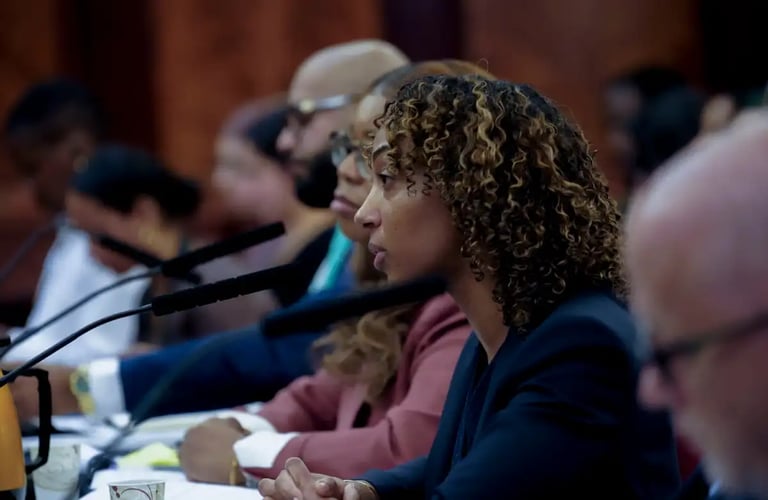

At the first City Council oversight hearing on Mayor Zohran Mamdani’s Office of Community Safety, lawmakers pressed officials on what the office has accomplished beyond expanding and coordinating existing programs in its first seven months.
Mamdani had initially proposed a $1 billion-a-year department with expanded violence-interruption programs and mental-health teams responding to 911 calls; instead, he established the Office of Community Safety in March as a first step, with $40 million allocated to it in the city’s FY 2027 budget.
The office brought five existing entities under one umbrella, spanning gun-violence prevention, mental health, domestic and gender-based violence, hate crimes, and victim services; the administration added $67 million for community-safety programs, bringing the combined FY 2027 budget to about $271 million.
Commissioner Ayesha Delany-Brumsey said the office is strengthening existing work while laying the groundwork for new initiatives, including better cooperation between domestic-violence and neighborhood-safety officials to arrange emergency housing transfers for crime victims and people facing retaliation.
Officials also cited expanded mental-health services for domestic-violence survivors and a $4.8 million expansion of the Crisis Management System, funding 42 new violence-prevention positions in Bushwick, Harlem, and Washington Heights/Inwood.
Lawmakers examined B-HEARD, which sends emergency medical and mental-health personnel rather than police to some 911 calls; it operates in 31 precincts and is seeking expansion, while 27 FDNY EMS and NYC Health + Hospitals staff recently completed integrated training—the program’s first such training since 2024.
Officials acknowledged that the city lacks a comprehensive way to track longer-term outcomes after B-HEARD responses; Health + Hospitals staff make follow-up calls, and a data-sharing agreement is being developed to improve tracking.
Delany-Brumsey said the office now communicates daily with NYPD personnel and meets weekly with police leadership, but does not regularly attend CompStat crime-strategy meetings; she could not recall when she last met Police Commissioner Jessica Tisch.
The administration is working with the Council on legislation to create a permanent Department of Community Safety; Council Member Lincoln Restler said his bill, Intro. 403, has 34 Council supporters, with amendments under discussion but no details or timeline announced.
Restler says the proposed department would coordinate homeless and mental-health services, de-escalate emergencies, and expand violence-interruption and other public-safety work by nonprofit organizations.
The office currently relies on other agencies for payroll, contracting, and administrative services as an interagency task force plans its transition to an independent department; Delany-Brumsey said the future agency should both deliver services directly and coordinate existing programs, while noting that government reorganizations can take years.
The debate is sharpened by Minneapolis, where the Office of Community Safety—created in 2022 and responsible for police, 911 responders, the fire department, and neighborhood-safety groups—was voted out by the City Council, which said it had not delivered results commensurate with its cost or improved police oversight; New York’s office does not oversee those emergency and law-enforcement services.
Summary based on 3 sources
Get a daily email with more US News stories
Sources


amNewYork • Oct 31, 2026
Seven months in, City Council asks Mamdani’s community safety office: What’s actually new?
Reason Magazine • Oct 30, 2026
New York City Council votes to scale up Office of Community Safety