CNN Poll: Independents Surge to Decade-High, Shifting Political Landscape Ahead of Midterms
June 16, 2026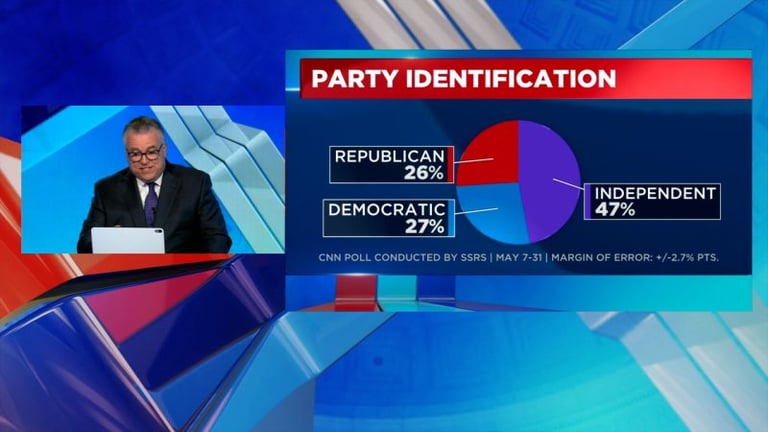

In a midterm-year CNN poll, Democrats narrowly outpace Republicans among registered voters (31% to 28%), while 41% identify with neither party, signaling a shift away from the GOP since 2024.
Young voters under 45 show a notable decline in Republican identification (from 26% in 2024 to 17%), while Democratic identification stays around one-third with about half not identifying with any party.
Since 2024, independents now comprise about 47% of registered voters, with Democrats at 27% and Republicans 26% without leaners; when leaners are included, 39% lean Democratic, 37% lean Republican, and 25% do not lean.
Political analysts note that the rising independent bloc could reshape messaging, candidate selection, and turnout strategies for upcoming elections.
The growing independence of voters is presented as a potential challenge for both parties ahead of the midterms.
CNN poll finds 47% of Americans identify as independents, the highest share in more than a decade.
The same data show independence reaching a decade-high 47%, up from 36% in 2021.
The article suggests party labels are becoming less predictive for voters, which could influence campaign tactics and outcomes.
Independents are not uniformly centrist; many lean toward a major party, and CNN analyses note diverse types of independents with varying engagement and views.
The poll was conducted May 7–31 among 2,480 adults by SSRS, with a margin of error of ±2.7 percentage points.
Independents tend to be urban-dwelling and lower-income, with about half earning below $50,000 annually.
Independents are generally younger, less politically engaged, and less likely to be registered to vote (67%) compared with partisans (over 80%).
Summary based on 2 sources