OpenAI Built Pando to Handle Codex’s Git Surge, Cutting Push Latency by 80%
November 3, 2026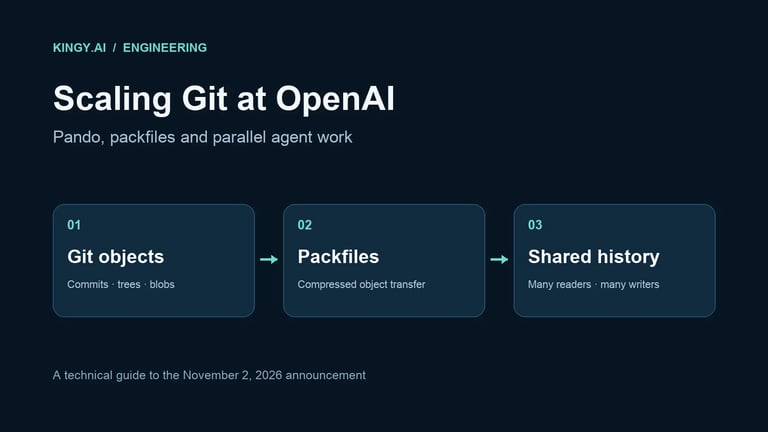

OpenAI built Pando, an in-house Git backend, after Codex’s growth drove a surge in concurrent branch activity that strained the company’s legacy system; it now supports all monorepo development and serves about 1 petabyte of Git data each day.
OpenAI concluded that conventional Git server architecture—not primarily Git’s client or protocol—was the bottleneck, and chose to scale the backend while retaining Git compatibility.
Pando was designed around two goals: scaling writes across branches and delivering high-throughput reads.
The backend stores incoming Git packfiles as blobs in cloud object storage, tracks branch versions and dependencies in a metadata service, and reuses stored packs rather than generating a custom packfile for every fetch.
Unlike systems that coordinate writes across every branch, Pando updates branches independently, so unrelated pushes do not block one another; the tradeoff is that a client reading multiple branches may see them at slightly different moments.
OpenAI says Pando provides per-reference serializability and read-your-own-write behavior, but not a globally consistent snapshot across all branches.
For reads, Pando uses Git’s packfile-URI feature to provide links to reusable packfiles, while the fetch response itself contains an empty pack.
Background workers compact smaller packfiles into progressively larger covers, an approach similar to log-structured merge-trees that helps select the data needed for fetches and searches through repository history.
Pando’s regional Express caches report hit rates above 99%, and OpenAI says clone and fetch operations can saturate 10 Gbps links on standard cloud virtual machines.
To avoid advertising millions of refs, Pando generally uses trunk as the base for new feature-branch pushes; this can mean resending history not in trunk, although the median pack in OpenAI’s monorepo is under 20 KiB.
By late 2025, delays and merge failures had become frequent and infrastructure reliability sometimes fell below 90%; OpenAI says Pando has reduced median push latency by about 80% and improved merge reliability.
OpenAI migrated without downtime, first running Pando as a read/write proxy before moving developers and hundreds of integrations through an internal Git CLI wrapper.
Summary based on 9 sources
Get a daily email with more Tech stories
Sources

The New Stack • Nov 3, 2026
OpenAI built itself a new Git backend, too
Interesting Engineering • Nov 3, 2026
OpenAI builds custom Git backend in just 10 weeks to handle 2,442% code commit surge
Blockchain.News • Nov 3, 2026
OpenAI details Pando, a Git-compatible backend for Codex-scale development
CybersecurityNews • Nov 3, 2026
OpenAI Builds Pando Git Infrastructure Using AI Agents and Deploys Continuous Security Testing