Google DeepMind Unveils Genie 4: A New Era in AI World Modeling
October 27, 2026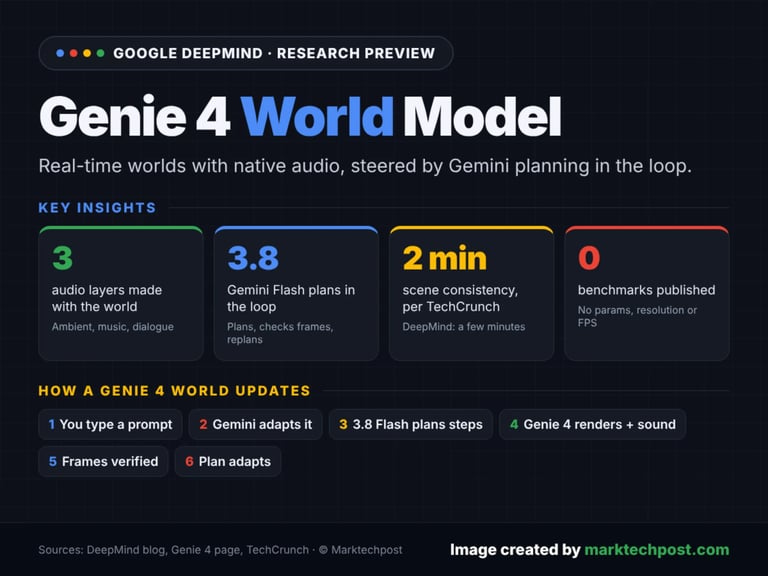

Key components include Gemini Omni for look and behavior, and Gemini 3.8 Flash for planning and frame verification within the loop.
Genie 4 is Google DeepMind’s new world model that renders interactive, real-time environments with simulated physics, human motion, and native audio, enabling multi-step task testing for AI agents.
Users can initiate events and have Genie 4 simulate subsequent world reactions, including visuals, sounds, and human movement and speech.
The system highlights four capability areas: real-time control via natural language; realistic physics and human action (including aerodynamics and collisions); native ambient audio and adaptive dialogue; and multi-step events guided by Gemini 3.8 Flash for planning, causality, and task progression.
The article does not disclose benchmarks or full technical specifications such as resolution or frame rate.
Industry context notes ongoing competition from Anthropic and OpenAI, with observers awaiting benchmark results to gauge relative performance.
Market reaction shows cautious optimism about Google’s AI leadership, with end-of-2026 pricing indicating a dip in confidence among investors.
Genie 4 will roll out in stages—from trusted testers to Google AI Ultra subscribers and partners—alongside watermarking (SynthID) and safety evaluations.
Google warns longer simulations may drift in details and object permanence over time.
The announcement signals progress in interactive world modeling, but lack of technical details leaves immediate impact uncertain.
DeepMind notes limitations such as drift in long sessions, short session duration, imperfect real-world location accuracy, limited legible text beyond input, and challenges in real-time audio accuracy and multi-agent interactions.
Benchmark results for Genie 4’s performance across repeated tests have not been published, raising questions about reliability and repeatability.
Summary based on 8 sources
Get a daily email with more Tech stories
Sources

TechCrunch • Oct 27, 2026
Google’s Genie 4 world model adds audio, more realistic worlds, and real-time steering
The Verge • Oct 27, 2026
Google’s next Genie AI model generates more realistic experiences
The New Stack • Oct 27, 2026
Google built AI agents a world to practice in. The physics still aren’t quite right.
Digital Trends • Oct 27, 2026
Google’s Genie 4 lets you edit AI generated worlds in real time, complete with sound and dialogue