GLM-5.2 AI Model Outperforms GPT-5.5, Offers Cost-Effective Solutions for Developers
June 16, 2026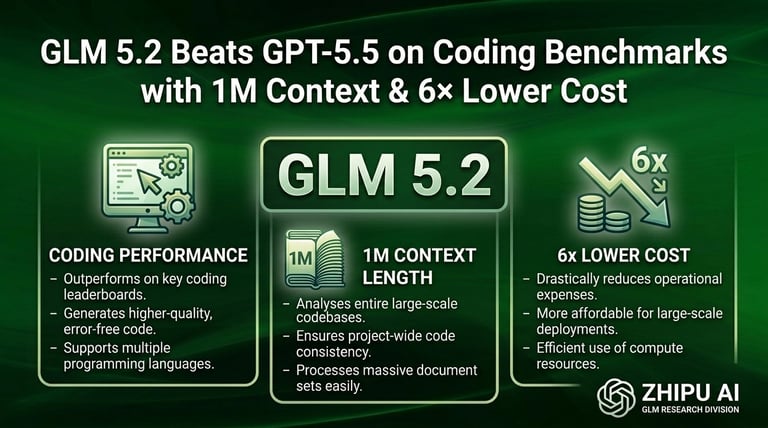

GLM-5.2, an open-weight AI model from Z.ai, released in mid-June, posts a long-horizon coding score of 34.3 on benchmarks, outperforming GPT-5.5 but just behind Claude Opus 4.8 by a single point.
Positioned as a top performer on FrontierSWE and PostTrainBench, GLM-5.2 demonstrates strong real-world software engineering and post-training task capabilities.
The model is immediately accessible via Hugging Face, Z.ai API, and about 20 third-party coding platforms for developers and enterprises.
To support 1M-context inference, GLM-5.2 employs efficient serving strategies, including LayerSplit memory management, optimized kernels, cache management, and CPU-side scheduling to boost throughput.
Enterprise subscriptions start at $12.60 per month, offering a cost-effective alternative to proprietary AI systems.
Users can adjust effort levels to balance capability, latency, and cost, with a Max effort option enabling extra computation for hard tasks while preserving token budgets.
Prime weights are released under the MIT open-source license, enabling download, fine-tuning, and deployment with control over costs, safety, and data privacy.
GLM-5.2 signals a broader move toward decentralized AI and increased competition in the model market, with observers warning of potential margin pressure for API-based providers.
The RL approach uses a critic-based PPO for long-horizon work, plus an anti-hacking module to prevent reward hacking while continuing rollouts with dummy results when needed.
MTP improvements, including IndexShare and KV-share, stabilize training and inference and boost accepted length by roughly 20% over baseline.
Industry reaction is upbeat about rapid integration and economic advantages, with developers citing immediate usability from Kilo Code, Cline IDE, and Eigent AI.
Notably, the release contains no blockchain or cryptocurrency integrations, signaling a clear separation from fintech AI trends.
Summary based on 9 sources
Get a daily email with more Tech stories
Sources

VentureBeat • Jun 16, 2026
Z.ai’s open-weights GLM-5.2 beats GPT-5.5 on multiple long-horizon coding benchmarks for 1/6th the cost
Hugging Face • Jun 17, 2026
GLM-5.2: Built for Long-Horizon Tasks
Economic Times • Jun 17, 2026
China's Z.ai GLM-5.2 tops OpenAI’s GPT 5.5 model on key benchmarks
Economic Times • Jun 17, 2026
China's Z.ai GLM-5.2 tops OpenAI’s GPT 5.5 model on key benchmarks