Claude Shannon: The Visionary Who Revolutionized Information Theory and Pioneered AI
April 13, 2026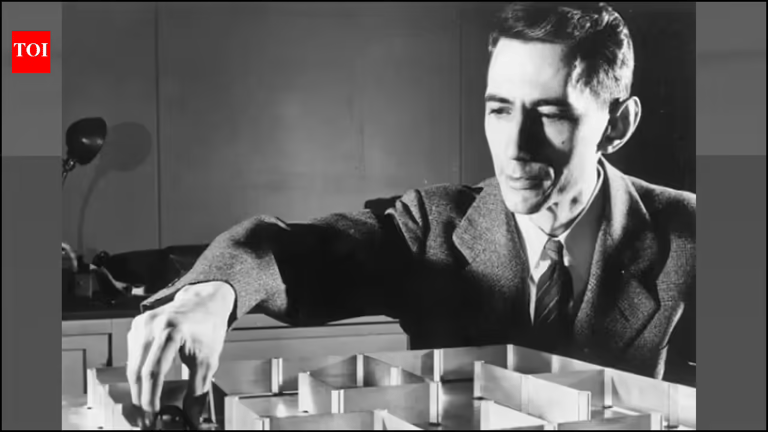

The Father of Information Theory, Claude Shannon, is celebrated for his 1948 paper that laid the groundwork for the digital age and established a mathematical theory of information.
In the same work, he introduced entropy as the measure of information, defining the bit, channel capacity, and a unified framework for communication across telephones, radios, and computers.
Shannon helped spark the field of artificial intelligence by organizing the Dartmouth Workshop, widely regarded as its official starting point.
Among his early experiments, Theseus the Mouse in 1950 demonstrated trial-and-error learning and memory in maze navigation, one of the earliest machine-learning demonstrations.
Beyond theory, Shannon was known for playful innovations and gadgets; his career spanned Bell Labs and MIT, where he conducted research until 1978 and lived with Alzheimer’s disease until his death in 2001.
During World War II, Shannon contributed to cryptography at Bell Labs, showing that perfect secrecy is possible and influencing the evolution of modern cryptography from DES to AES.
His 1937 MIT master’s thesis showed that Boolean logic could be realized physically with electrical circuits, enabling hardware-based logical reasoning and the birth of modern computing.
Shannon’s legacy continues to shape AI and data transmission, informing concepts like cross-entropy loss, information gain in decision trees, and perplexity in language models.
Taken together, Shannon’s ideas provide the essential language and mathematical framework for understanding and building digital communication, encryption, and AI systems used worldwide.
Summary based on 1 source
Get a daily email with more Tech stories
Source

The Times Of India • Apr 13, 2026
Who is Claude Shannon and how the father of information theory laid the foundation of AI and the internet