Astronomers Spot Twin Supermassive Black Holes Poised for Merger in Distant Galaxy
April 7, 2026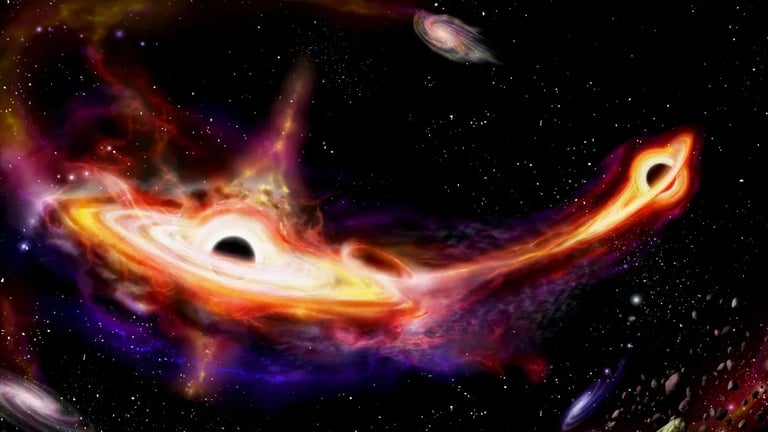


A team from Germany’s Max Planck Institute for Radio Astronomy has detected a real pair of supermassive black holes in the galaxy Markarian 501, providing strong evidence that mergers contribute to black hole growth.
After analyzing 23 years of radio observations, scientists report two closely orbiting supermassive black holes at Markarian 501’s center, suggesting they are on track to merge.
The system lies about 440 million light-years away, making the final merger unlikely to be observed directly, but dual-jet activity offers compelling evidence of growth through mergers.
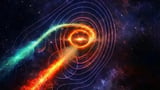
Two jets originate from Markarian 501’s core, with a second jet initially trailing the first and then moving counterclockwise around it, even briefly forming an Einstein ring through gravitational lensing.
In June 2022, observations captured an Einstein ring created by lensing, supporting the dual-black-hole scenario as light from the second jet behind the foreground jet was bent.
The inferred orbital period is about 121 days, with the black holes separated by roughly 2.5 to 5.4 astronomical units, a remarkably compact distance for objects of their mass.
Kinematic analysis indicates the pair completes orbits roughly every 121 days, with masses estimated from 100 million to 1 billion solar masses.
This system offers a rare opportunity to monitor a supermassive black hole merger as orbital dynamics and gravitational-wave signals evolve, shedding light on giant black hole growth.
Researchers estimate a potential merger within about a century, which would emit extremely low-frequency gravitational waves detectable by pulsar timing arrays and similar instruments.
The projected merger would produce low-frequency gravitational waves that future detectors could observe, advancing our understanding of black hole coalescence.
The discovery strengthens the merger-growth hypothesis for supermassive black holes and showcases the value of long-term radio observations in tracing jet dynamics and black hole interactions.
Summary based on 2 sources