Breakthrough Molecule with Switchable Topology Poised to Revolutionize Drug Discovery via Quantum Computing
March 31, 2026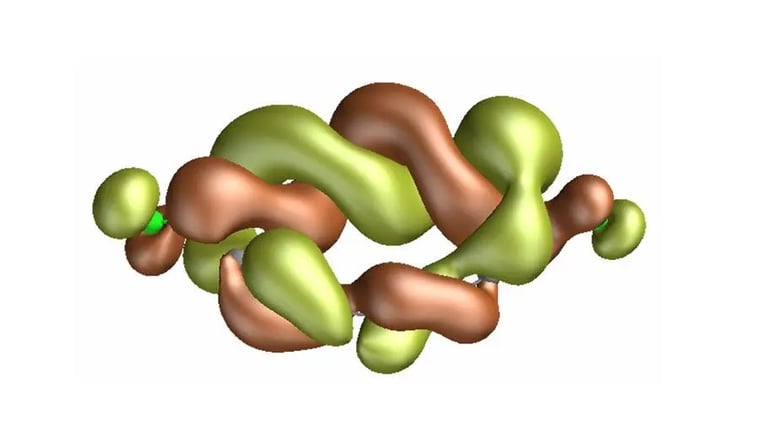

Researchers from IBM and multiple leading universities report the creation and characterization of a new molecule, C13Cl2, with a unique half-Möbius topology that can switch between right-handed half-Möbius, left-handed half-Möbius, and a topologically trivial state, altering how its electrons behave.
The work outlines a potential future workflow where quantum computing models drug candidates at electronic-level fidelity far beyond classical methods, potentially speeding drug discovery and reducing trial-and-error in pharmaceutical development.
The effort builds on IBM’s long history with quantum hardware and nanoscale science, including the development of the scanning tunneling microscope, to simulate and understand complex molecular behavior.
Using a specialized algorithm called SqDRIFT, researchers explored an active computational space of 2^100, revealing the molecule’s lowest-energy state and explaining the half-Möbius topology through a helical pseudo-Jahn-Teller effect and twisted molecular orbitals during electron attachment.
The molecule’s topology forces its electronic structure to require multiple loops for the phase to return to its starting point—a property not previously observed in molecules.
Experiments were conducted on IBM superconducting-qubit quantum processors via the IBM Quantum Platform, at near-absolute-zero temperatures and in ultra-high vacuum, using precise voltage pulses to study the molecule.
The article notes potential industry impact and frames this as an inflection point in quantum computing history, while also disclosing the authoring firm’s paid relationship with IBM.
The switchable topology could enable new materials and devices, including quantum sensors, chiral sensors, spin filters, and advanced information storage, potentially transforming electronics, drug discovery, and materials design by treating topology as a controllable degree of freedom.
Summary based on 1 source
Get a daily email with more Tech stories
Source
Forbes • Mar 30, 2026
Quantum Computing Built An Impossible Molecule — With Big Implications