Oracle Enhances AI Studio: New Builder, Security, and Workflow Features for Enterprise Automation
March 25, 2026

Alibaba unveils Wukong, an enterprise AI agent platform that connects with corporate data systems to automate task execution, signaling a shift toward end-to-end AI-driven process management across industries.
Alibaba’s Qwen suite has surpassed 1 billion cumulative downloads, with consumer apps drawing over 300 million monthly users and more than 400 enterprises running AI workloads on Alibaba infrastructure; over 470,000 AI chips shipped, with about 60% deployed externally.
Alibaba’s AI and cloud strategy is built on a full-stack approach—chips, cloud, foundation models, model-as-a-service, and enterprise/consumer apps—to drive broader enterprise adoption and tighter ecosystem integration.
The program-of-record designation is a tactical win but tempered by dependency on Anthropic, which could threaten long-term profitability and execution if not resolved.
Reuters and Bloomberg have reported on the Pentagon’s Maven program of record plans as a backdrop for military AI initiatives.
The AI-first concept aims to accelerate decision cycles and information processing to preserve military superiority, leveraging US advantages in innovation, industry, and operational data.
Near-term watchpoints include: whether multi-year funding accelerates under revised oversight, how Palantir handles the Claude-AI transition and system performance, and whether the pivot to agentic AI capabilities proceeds on schedule to enhance kill-chain management.
Technical emphasis on Deep Data Security and Trusted Answer Search to reduce LLM hallucinations and prompt injection, using native row-level/column-level security and deterministic retrieval.
Designation secures multi-year funding, reduces procurement uncertainty, and expands Maven’s adoption across the Joint Force, reinforcing its role as a foundational AI operating system for US military and NATO operations.
IT leadership is addressed by prioritizing domain-specific AI agents, measurable outcomes, and safeguards to maintain control over automated decisions.
Analysts differ on Oracle: some see standard features as table stakes, while others view a potential differentiator in unified memory and in-database AI, though skepticism remains about meaningful differentiation.
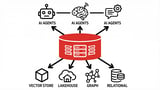
Industry notes that the data layer, not the model, is where production AI deployments struggle due to latency, governance, and fragmented access across distributed data estates.
Summary based on 25 sources
Get a daily email with more Tech stories
Sources

VentureBeat • Mar 25, 2026
Oracle converges the AI data stack to give enterprise agents a single version of truth
ComputerWeekly.com • Mar 25, 2026
Oracle applications chief sees enterprise AI agents as task-specific helpers