Microsoft Unveils Project Silica: Revolutionary Glass Data Storage Promises Millennia of Preservation
February 18, 2026


Microsoft researchers reveal Project Silica’s glass-based data storage, using femtosecond lasers to engrave nanoscale voxels in borosilicate glass, potentially enabling millennia-scale archival libraries.
The system provides an end-to-end solution for writing and reading data in glass, with automated microscopy and a machine-learning decoder to translate voxel patterns into usable information.
Initial benchmarks show multi-beam writing can reach high throughputs, with birefringent and phase voxel methods offering different trade-offs in density, energy efficiency, and hardware requirements.
Accelerated aging studies suggest data durability lasting thousands of years at room temperature, underscoring the potential for centuries-long preservation.
Two complementary writing methods are used: pseudo-single-pulse writing for birefringent voxels and single-pulse writing for phase voxels, each around 10 MHz, enabling higher throughput and energy efficiency.
A representative experiment stored about 4.8 terabytes in a compact glass sample, demonstrating practical density at a millimeter-scale thickness.
Data is read by imaging each layer with automated microscopy and decoding via a neural-network-based pipeline coupled with LDPC error correction for robust recovery.
The technology projects densities up to several gigabits per cubic millimeter, with thousands of layers achievable in a small glass volume, highlighting significant archival potential.
The work envisions deployment in data centers and national libraries, bridging materials science with real-world archival needs, though at high initial costs for deployment.
Future directions include scaling through higher laser repetition rates, more beams, and exploring alternative glass compositions to improve throughput and durability.
The research documents data durability through 4D encoding (voxel plus light phase) and plans for closed-loop production to support industrial-scale replication.
Industry interest is broad, with potential players beyond Microsoft exploring glass-based storage for long-term archival applications, while consumer-use hardware remains distant.
Summary based on 10 sources
Get a daily email with more Tech stories
Sources

The Guardian • Feb 18, 2026
Stone, parchment or laser-written glass? Scientists find new way to preserve data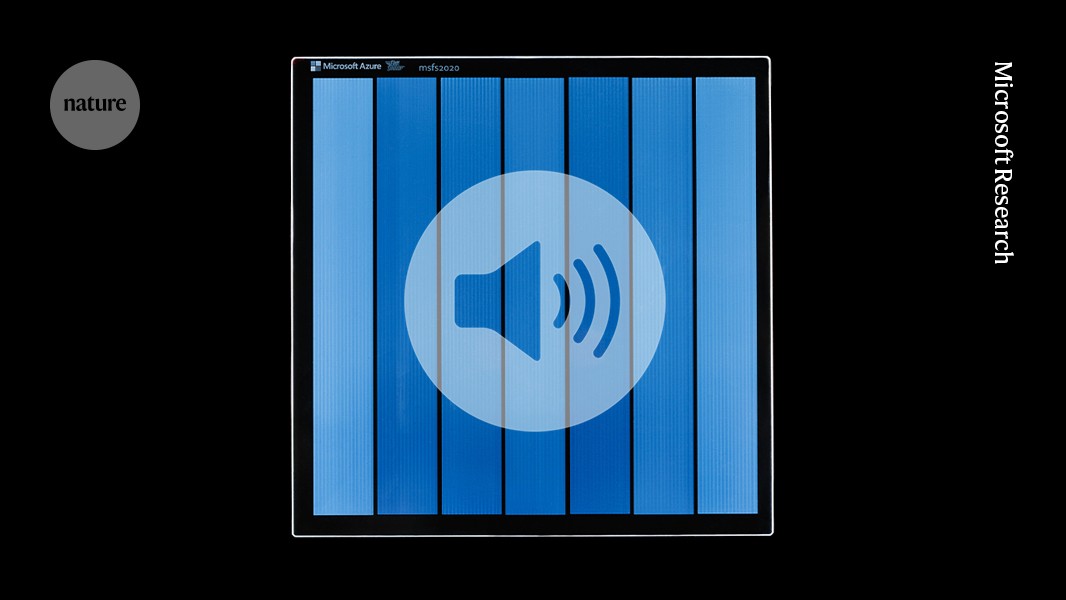
Nature • Feb 18, 2026
This chunk of glass could store two million books for 10,000 years
Nature • Feb 18, 2026
Laser writing in glass for dense, fast and efficient archival data storage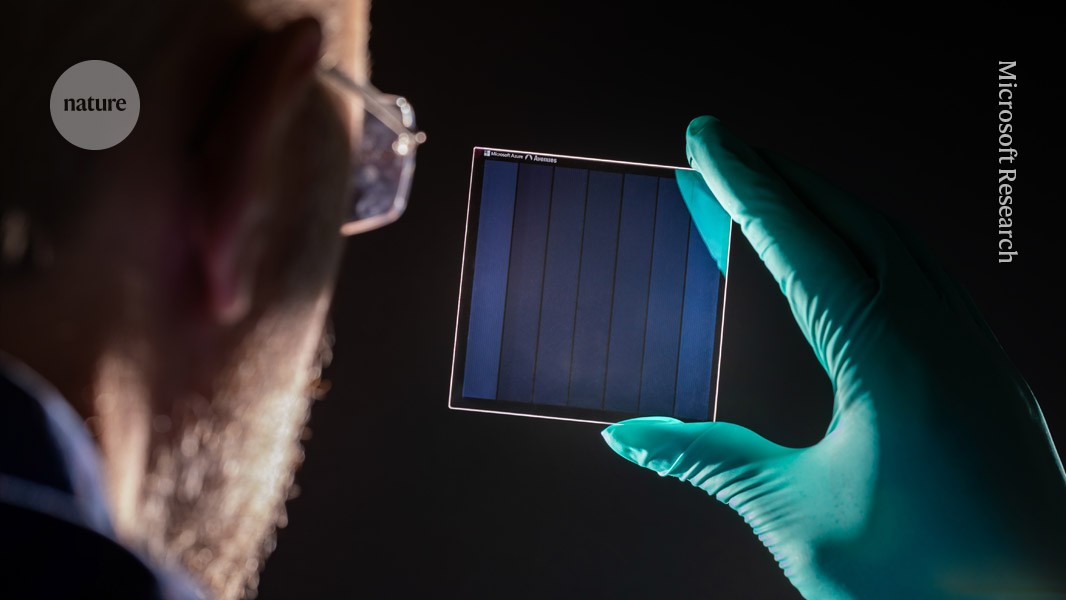
Nature • Feb 18, 2026
Microsoft team creates 'revolutionary' data storage system that lasts for millennia