New Technique Reveals Exoplanet Hidden in JWST Images, Boosting Sensitivity Up to 15-Fold
November 4, 2026

Northwestern University researchers developed FLIP, a physics-based image-processing technique that removes residual starlight from James Webb Space Telescope (JWST) images and improved sensitivity to faint planets by two to 15 times in tests of existing observations.
Directly imaging exoplanets can reveal details about their atmospheres and surfaces, but stars vastly outshine their planets and imperfect telescope optics make the task difficult.
Conventional methods subtract a reference image of another star, but even small changes in telescope alignment and optics can make that reference inaccurate, leaving starlight that hides nearby planets.
FLIP instead uses a digital twin of the telescope, combining a physical model with wavefront-sensing data and adjusting it to match the instrument’s state during the science observation; it relies on physics-based modeling and optimization, not AI.
To guard against the model subtracting a real planet along with the starlight, the team adds simulated planets to images and tracks their signal during optimization, stopping when it peaks or levels off.
Tests on JWST observations of HIP 65426, 51 Eridani and TYC 5899 showed that FLIP consistently outperformed conventional processing without requiring any changes to the telescope.
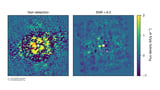
A striking result came from 51 Eridani b: FLIP detected the known planet in a JWST observation at 4.3 micrometres, where standard processing had failed to distinguish it from the star’s glare.
The 4.3-micrometre observation is the first image of 51 Eridani b at that wavelength, which includes a carbon-dioxide absorption band that could help future studies assess the planet’s atmospheric metallicity.
For TYC 5899, whose reference-star images were taken four months before the science observation, FLIP improved sensitivity by up to about 15 times at 0.5 arcseconds and about five times at 1 arcsecond.
More sensitive processing could help researchers find smaller, colder and fainter planets in data JWST has already collected, as well as study known planets at wavelengths that reveal more about their atmospheres.
JWST can currently detect planets roughly the size of Saturn when they orbit far from their stars, while imaging Earth-sized worlds directly would require a telescope 100 to 1,000 times more stable, according to study lead Rodrigo Ferrer-Chavez.
The team is reprocessing hundreds of existing JWST coronagraphic images to look for additional planets, and hopes the approach could eventually become routine and reduce observing time.
Summary based on 7 sources
Get a daily email with more Science stories
Sources
AAAS logo • Nov 4, 2026
Astronomers sharpen JWST’s view of distant worlds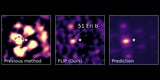
Scientific American • Nov 4, 2026
NASA’s James Webb Space Telescope is wobbly—scientists have a fix that could reveal new alien worlds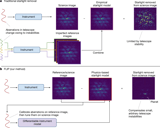
Nature • Nov 4, 2026
Imaging exoplanets below the telescope stability limit