NASA Bids Farewell to Swift Observatory as Rescue Mission Fails, Legacy Lives On
October 27, 2026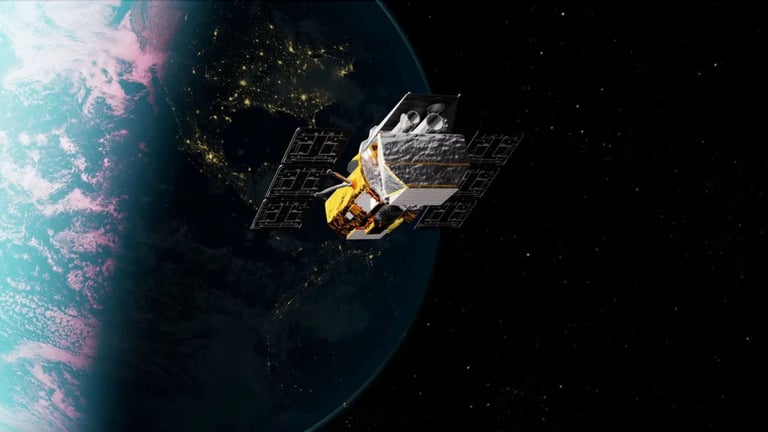

The Neil Gehrels Swift Observatory, NASA's long-running space telescope, is nearing atmospheric re-entry and will be lost after a private rescue mission failed to save it.
Over nearly 22 years in orbit, Swift gradually lost altitude, with NASA declaring the mission over as re-entry was expected around early November.
NASA formally ended the Swift mission following Katalyst Space Technologies’ unsuccessful rescue attempt to preserve or boost its trajectory.
During its life, Swift identified almost 2,000 gamma-ray bursts and offered crucial insights into neutron-star mergers that create heavy elements such as gold and platinum.
Launched in November 2004 and renamed the Neil Gehrels Swift Observatory in 2018, the telescope exceeded its original two-year design life by advancing high-energy astrophysics for more than two decades.
Researchers describe the mission’s end as dramatic and tragic, yet Swift leaves a rich data archive that will continue to fuel future discoveries.
Shawn Domagal-Goldman, NASA’s Astrophysics Division director, stressed that the effort pushed servicing technology and rapid-response observations, even though it could not save Swift.
NASA announced the mission’s end on Oct. 23, noting final data collection on Oct. 20 and underscoring the ongoing value of Swift’s archival data for future science.
Katalyst’s LINK spacecraft aimed to rendezvous with Swift, capture it, and boost its orbit, but propulsion and attitude-control issues prevented a successful capture or boost.
NASA awarded a $30 million contract in September 2025 to pursue private rescue efforts, marking an unprecedented private servicing attempt for an unmodified observatory.
Across its mission, Swift observed over 2,000 gamma-ray bursts, more than 1,400 supernovae, and contributed to roughly 7,000 scientific papers, cementing its impact on astrophysics.
Originally focused on gamma-ray bursts, Swift expanded to cover supernovae, comets, black holes, and neutron-star mergers, broadening our understanding of high-energy phenomena.
Summary based on 2 sources
Get a daily email with more Science stories
Sources
Nature • Oct 27, 2026
Revered NASA spacecraft is about to perish in flames — astronomers are mourning
Space • Oct 26, 2026
NASA ends Swift space telescope mission after failed rescue attempt