New Study Sheds Light on Venus Cloud Absorber Mystery, Challenges Inorganic Theories
September 13, 2026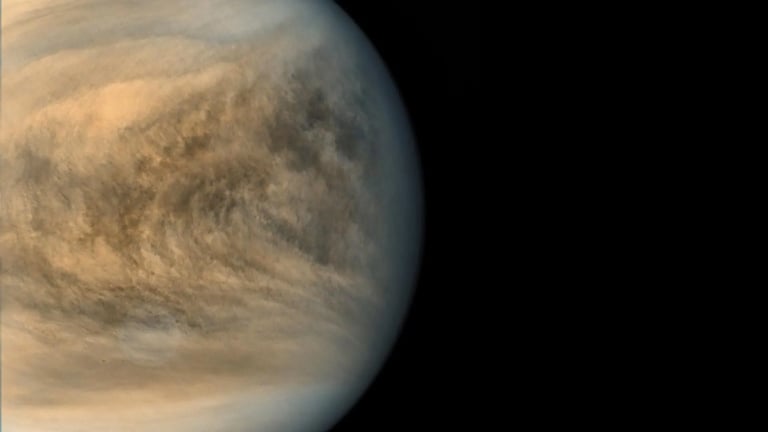

Researchers set new numerical limits on the Venusian cloud absorber by pairing Venus observations with radiative-transfer models to quantify how strongly the cloud droplets would absorb ultraviolet and blue light.
The constraints also apply to inorganic candidates, which would need unrealistically high concentrations to match the observed absorption.
The study does not prove life or identify the absorber; it outlines stringent criteria and notes that future lab work and in situ measurements are needed to test the constraints.
sharp absorption in the 365–455 nm band points to a chemically defined material unlikely to form tar-like organic mixtures in concentrated sulfuric acid, narrowing the candidate pool.
The researchers consider how the cloud material would look if collected in a spectrometric cuvette as a bulk liquid, underscoring that cloud particles can act differently from bulk material.
The findings specify quantitative requirements—absorption efficiency, concentration, distribution, and compatibility with observed cloud-particle sizes—that any absorber must satisfy, whether organic or inorganic.
Future missions under the Morning Star program, including the Autofluorescence Nephelometer for a Venus mission, aim to detect organic signatures and directly study Venus’s cloud chemistry to validate the constraints.
A class of highly absorbing carbon-based conjugated organics could plausibly explain the strong absorption, potentially at about 10 g/L, though researchers stop short of naming pigments like chlorophyll.
Venus’s ultraviolet image shows dark and bright cloud features caused by an unidentified absorber in the upper sulfuric acid clouds, a mystery spanning a century.
The model integrates scattering and absorption by droplets and atmosphere to convert astronomical data into lab-relevant absorption coefficients, yielding a decadic coefficient near 1,278 cm−1 at 375 nm within the 365–455 nm range.
Summary based on 1 source
Get a daily email with more Science stories
Source
ScienceDaily • Sep 12, 2026
Venus’s pale yellow clouds may hide something surprisingly dark