Poxvirus Breakthrough: E5 Polymerase Activation Key to Efficient Genome Replication and RNA Primer Synthesis
September 2, 2026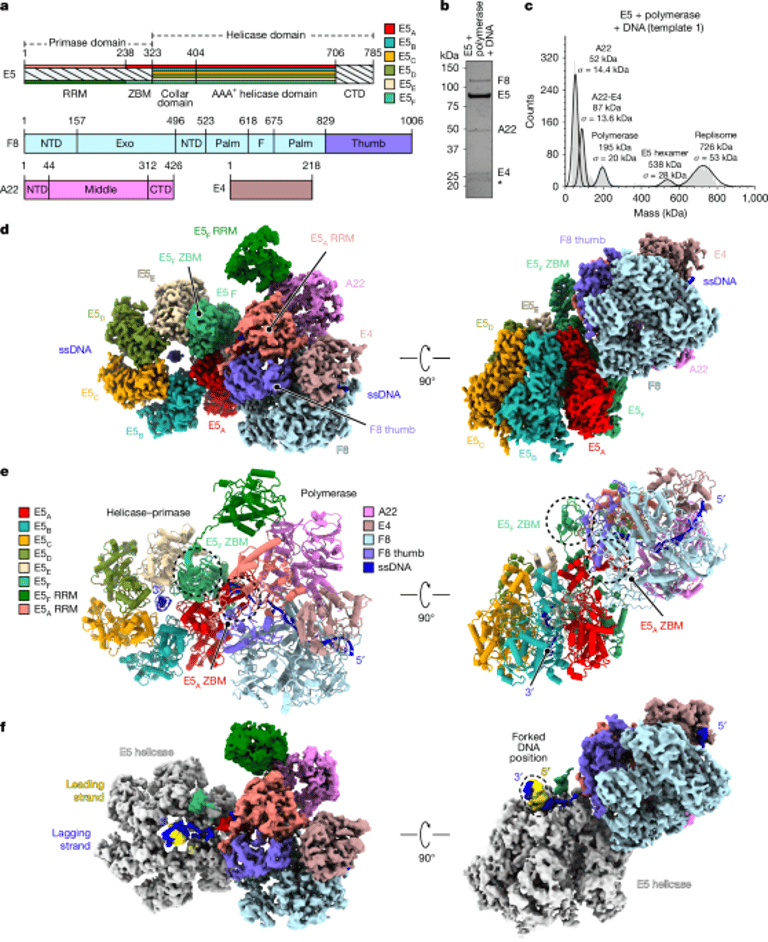

Activation occurs when the E5-bound polymerase triggers large-scale conformational changes that unfold the E5 DNA entry channel, activating helicase activity and boosting primase function.
The MPXV replisome consists of a hexameric E5 helicase–primase complex and the polymerase holoenzyme (F8–A22–E4); assembly requires DNA templates and hairpin structures, with DNA binding guiding proper complex formation.
In RNA elongation, the RNA recognition motifs shift their contacts, allowing room for the RNA product and potentially altering how the helicase engages the core complex.
The E5A ZBM and RRM coordinate with the polymerase to position the active site for RNA primer synthesis, with AlphaFold-predicted arrangements mirroring a conserved active-site setup similar to human PrimPol, including metal and nucleotide binding.
Functional assays show primase activity is enhanced by the polymerase, and disrupting polymerase–E5 interactions impairs RNA primer synthesis and overall replisome function.
Cryo-EM reveals two main structural regions: a ring-shaped E5 helicase and an irregular polymerase–E5 primase region, with E5A/E5F primase domains engaging F8 thumb and A22 to enable coordinated action.
Mutations that disrupt polymerase–E5 interfaces hinder replisome assembly and block helicase/primase activation, underscoring tight physical coupling between components.
The ssDNA passes through the E5 hexamer center toward the polymerase, with stabilizing contacts from E5A’s RRM and ZBM and F8 thumb residues guiding DNA through the replisome.
Overall significance: The findings show how MPXV coordinates helicase and primase activities with the polymerase to drive genome replication and primer synthesis, highlighting potential antiviral targets and advancing poxvirus biology.
Introductory overview: The study examines how the MPXV replisome operates, focusing on E5 helicase–primase and its interaction with the DNA polymerase holoenzyme to propel replication and RNA primer production.
Evidence for fork engagement: Density patterns for ssDNA bridging E5 and polymerase and a forked DNA substrate support a model where the replisome engages replication forks and accommodates dsDNA regions during elongation.
Single-molecule data from optical-tweezer experiments show polymerase presence markedly enhances E5 helicase activity, reducing pausing at higher polymerase concentrations and supporting polymerase-driven activation.
Summary based on 1 source
Get a daily email with more Science stories
Source
Nature • Sep 2, 2026
Structure and operating principles of a monkeypox virus replisome