Surprise New Jersey Quake Unveils Hidden Mountainville Fault, Redefines East Coast Seismic Risks
August 28, 2026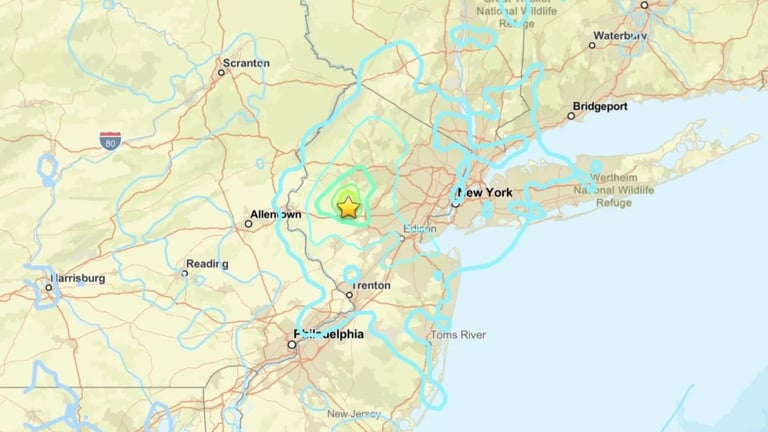

An April 2024 earthquake in Tewksbury, New Jersey, measured magnitude 4.8 and surprised residents from Virginia to Maine, prompting a search for its source.
Researchers combined aftershock data, field mapping, lab friction tests, stress analyses, and LiDAR to identify and characterize the fault behind the quake.
The event exhibited unusual rupture behavior, combining thrust and strike-slip movement along a north-northeast fault path, indicating a complex fault plane.
Initial suspicion pointed to the Ramapo Fault, but it was inactive at the time, leading scientists to pursue an alternate source.
Investigators traced the quake to a previously unmapped fault zone in the New Jersey Highlands, now named the Mountainville Fault.
LiDAR imagery showed the unmapped fault zone about 2 miles west of the epicenter, aligning with the observed aftershock pattern.
The fault has limited surface expression yet retains the capability to generate earthquakes.
This finding underscores that hidden, immature faults can pose seismic hazards even without extensive surface faulting.
The discovery highlights East Coast seismic hazards arising from lesser-known faults outside major, well-mapped systems, affecting risk assessments for densely populated hubs like New York City.
Although the quake caused no major damage, it remains the largest in New Jersey since 1900, underscoring the need to identify hidden fault structures for accurate hazard planning.
Summary based on 1 source
Get a daily email with more Science stories
Source
Gizmodo • Aug 28, 2026
Freak Earthquake That Hit New York in 2024 Came From a Hidden Fault Zone