Spectacular Lunar Eclipse to Grace American Skies: How to Watch and What to Expect
August 26, 2026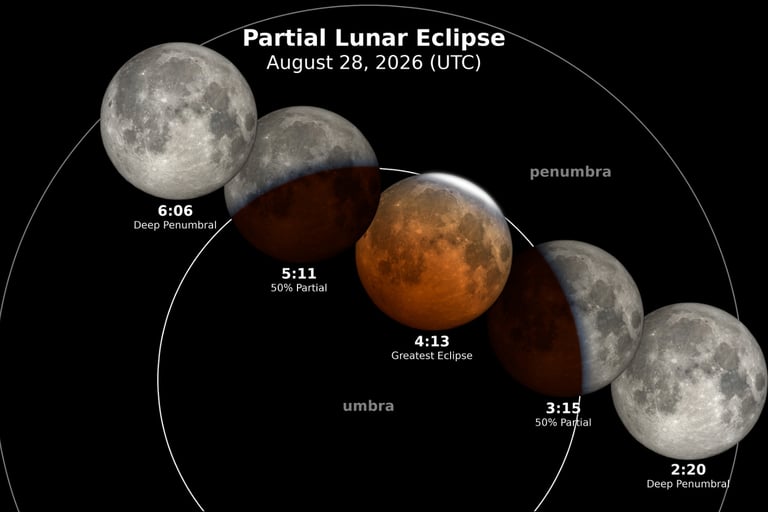


A near total lunar eclipse will be visible across much of North and South America on Thursday night, with about 96% of the Moon darkened at its peak.
Color changes of the Moon during the eclipse result from sunlight refracted by Earth’s atmosphere, with shorter wavelengths scattered and longer wavelengths (red/orange) predominating.
The eclipse timeline spans roughly five and a half hours, starting with the outer shadow at 9:23 p.m. ET, partial eclipse begins at 10:33 p.m. ET, maximum at 12:13 a.m. ET, partial eclipse ends at 1:51 a.m. ET, and the penumbral phase concludes at 3:01 a.m. ET.
Forecasts suggest mostly cloudy skies, but occasional openings in clouds may allow views, with the Ruth Patrick Science Education Center listed as a viewing hotspot; observers can also watch from other locations with a Moon view.
Experts note atmospheric factors that influence the exact hue and ease of viewing, including insights from university astronomers.
For more information, visit usca.edu/rpsec (events page: eclipses) to learn about viewing options.
No special equipment is needed to observe a lunar eclipse; it can be safely viewed with the naked eye, though binoculars or a telescope can enhance detail.
The article also notes that binoculars or a telescope can improve the experience and recommends practical tips such as avoiding light pollution and possibly checking livestreams or local observatories if skies are cloudy.
Observers are advised to survey the sky gradually, appreciate surrounding stars as the Moon dims, and note that this content originated from WIRED en Español and has been translated.
A free lunar eclipse viewing event is hosted by the Astronomy Club of Augusta and the DuPont Planetarium at the Ruth Patrick Science Education Center on the USC Aiken campus.
NASA and educational sources explain the mechanics of lunar eclipses—Earth blocking sunlight and atmospheric scattering shaping the color.
Weather outlooks vary by city, with some areas in New York State expecting showers or thunderstorms, potentially affecting visibility.
Summary based on 7 sources
Get a daily email with more US News stories
Sources
The Guardian • Aug 27, 2026
Near total lunar eclipse will be seen from North and South America Thursday night
WIRED • Aug 27, 2026
How to See the Partial Lunar Eclipse and Blood Moon on August 27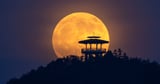
NBC News • Aug 26, 2026
‘Blood moon’ lunar eclipse will cross U.S. weeks after solar eclipse — here’s when to watch