ALADYNOULLI: Revolutionizing Disease Prediction by Linking Genetics and Health Trajectories
July 15, 2026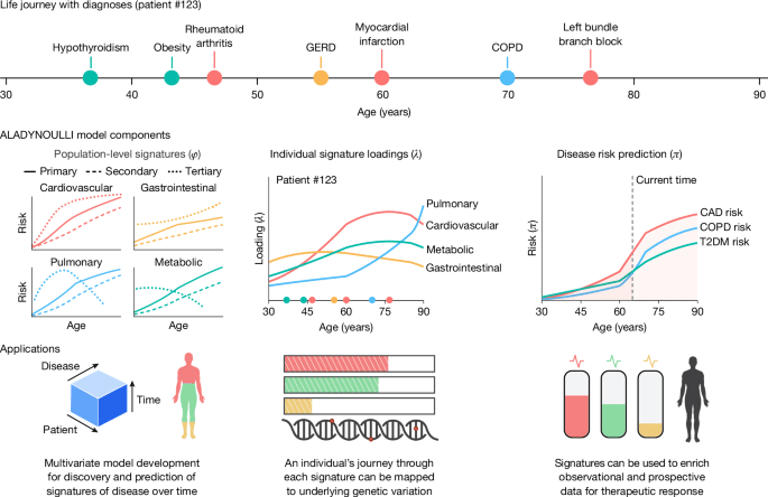


Rare variant burden analyses link genes like LDLR, APOB, and LPA to ischaemic cardiovascular signatures, TTN to heart failure, and TET2, PKD1, BRCA2 to infectious/critical-care signatures, supporting the biological relevance of the identified signatures.
The model enables retrospective discovery of signatures through full trajectory analysis and prospective prediction with temporal validation, ensuring that predictions rely only on information available up to each timepoint.
Overall, ALADYNOULLI enhances disease risk prediction, accelerates genetic discovery, and reveals patient subgroups within diagnostic categories by jointly modeling multiple diseases and their genetic determinants.
Genetic information is directly embedded in the model via Gaussian process priors on signature loadings, incorporating 36 polygenic risk scores and demographic factors to shape time-varying associations between signatures and diseases.
Heterogeneity within diseases is exposed through individual-specific loadings and time-varying trajectory profiles, enabling identification of subgroups with distinct signature compositions and progression patterns.
Clustering of time-averaged signature loadings reveals patient subgroups; effect-size metrics quantify inter-cluster differences, including distinct PRS patterns across clusters.
Disease risk is modeled as a weighted sum of signature-specific probabilities, with each signature capturing co-evolving diseases and their temporal dynamics, allowing prediction across multiple conditions and rare diseases via cross-signature information sharing.
Ancestry effects on signatures vary with age, showing that genetic background modulates signature enrichment across the lifespan, with cardiovascular signatures exhibiting ancestry-specific peaks.
Analysis of three large biobanks—UK Biobank, Mass General Brigham, and All of Us—identified 21 latent signatures (20 disease-related, 1 low-incidence) with stable cross-cohort patterns aligned to known clinical phenotypes.
Signatures show age-related temporal patterns, with atrial fibrillation, heart failure, and metastatic cancer following characteristic trajectories; early- and late-onset myocardial infarction display distinct signature contributions, hinting at different underlying processes.
ALADYNOULLI is a Bayesian generative model that fuses germline genetic data with longitudinal electronic health records to uncover latent disease signatures and map individual health trajectories over time.
Genetic architecture analyses link signatures to known risk loci, with GWAS identifying 151 significant loci across signatures, including LPA, APOE, PCSK9 for cardiovascular/metabolic traits and TCF7L2 for diabetes.
Summary based on 1 source
Get a daily email with more AI stories
Source
Nature • Jul 15, 2026
A Bayesian framework for longitudinal EHR and genetic discovery