ENCODE-rE2G: Revolutionizing Enhancer-Gene Prediction with CRISPR and eQTL Benchmarking
July 15, 2026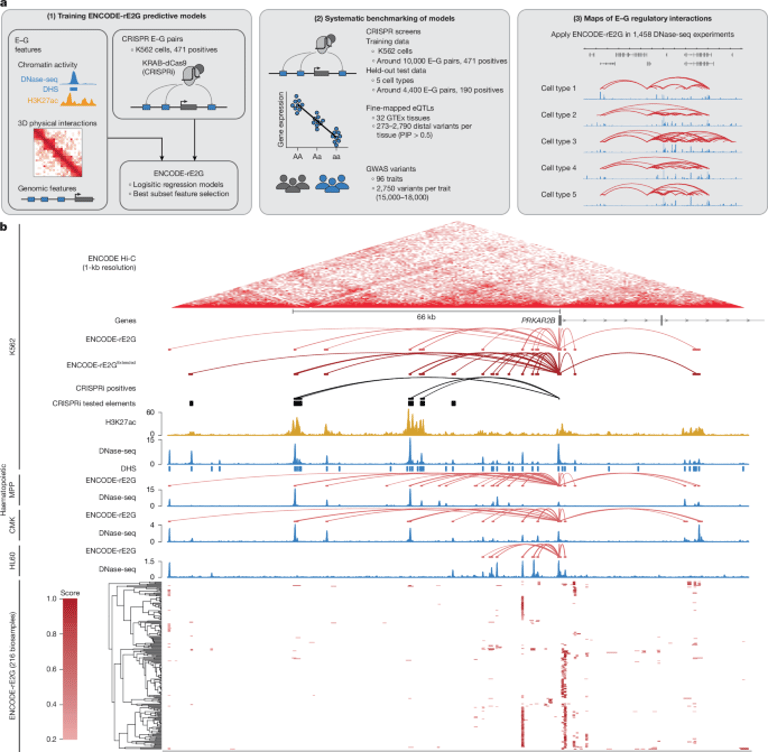

ENCODE-rE2G leverages benchmarking across diverse data types—CRISPR-validated pairs, fine-mapped eQTLs, and fine-mapped GWAS variants—to show improved recall and precision in predicting enhancer–gene relationships compared with many competing models.
A harmonized ENCODE benchmarking framework, built from CRISPR perturbations, eQTLs, and GWAS variants, treats regulatory interactions as the gold standard rather than mere physical contacts, guiding E–G model evaluation.
ENCODE-rE2G achieves state-of-the-art performance across tasks and cell types, excelling at predicting cell-type-specific enhancer–gene links, including performance on K562 data and external datasets.
Limitations include weaker performance on indirect or trans-acting interactions, weak CRISPR effects, non-canonical enhancers lacking H3K27ac, and interactions involving housekeeping genes, though generalization remains robust across multiple cell types and perturbation datasets.
Key features include DNase-seq signals, chromatin state, 3D contact frequency from ENCODE Hi-C, activity-by-contact scores, genomic distance to promoters, promoter class, and nearby enhancer activity within a regularized logistic regression framework.
Each element–gene pair gets a probability score, with a chosen threshold to achieve 70% recall on training data, producing genome-wide predictions of roughly 63,221 interactions per biosample for ENCODE-rE2G and 108,535 with the extended model.
The ENCODE atlas shows most predicted enhancer–gene interactions fall within 24–100 kb, revealing that a single gene can be regulated by multiple enhancers and that enhancers can regulate multiple genes with strong cell-type specificity.
The atlas enables queries for predicted enhancers for a gene, predicted target genes for an enhancer, and linking noncoding variants to likely regulatory mechanisms in specific cell types.
Across 1,458 ENCODE biosamples, the resource maps 92,176,227 predicted regulatory interactions, with enhancers typically interacting within 10–100 kb of targets, though many interactions are highly cell-type-specific.
The study promotes a community resource approach with open benchmarking pipelines to refine models and expand E–G maps to new cell types and contexts.
ENCODE introduces ENCODE-rE2G, a supervised model that predicts enhancer–gene regulatory interactions in specific cell types by integrating chromatin features and 3D genome data, trained on CRISPR perturbation results.
Summary based on 1 source
Get a daily email with more Science stories
Source
Nature • Jul 15, 2026
An encyclopedia of human enhancer–gene regulatory interactions