Global Underground Fungal Network Mapped: Key to Climate Resilience and Food Security
July 5, 2026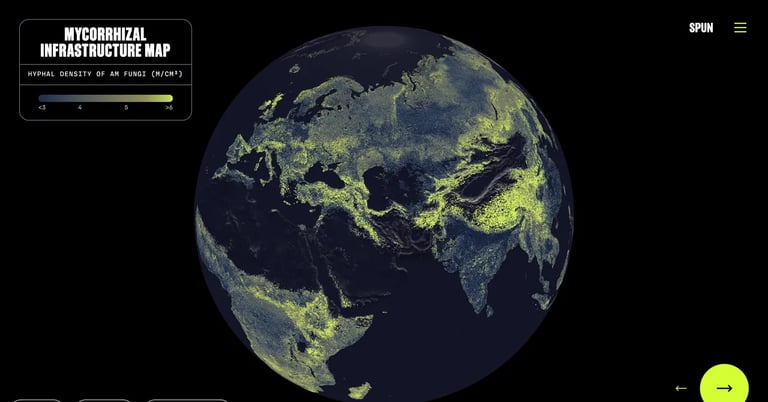

A global map of the underground mycorrhizal fungal network has been produced for the first time, estimating a total length of about 110 quadrillion kilometers and a biomass of roughly 300 megatons of carbon.
Lead author explains the scale and importance, while coauthors note the potential for fungi-informed approaches to bolster climate resilience and food security.
Network density is higher in natural ecosystems than in agricultural soils, with grasslands contributing about 40 percent of the world’s arbuscular mycorrhizal biomass but facing rapid conversion to agriculture, threatening soil carbon storage and nutrient recycling.
In soil, a teaspoon can contain up to 10 meters of mycorrhizal network, underscoring the microscopic reach and its climate and agricultural implications.
Arbuscular mycorrhizal fungi form symbiotic relationships with plant roots, supplying water and nutrients in exchange for carbon, and are essential for the survival of about 70 percent of plant species.
The study synthesizes data from 322 previous studies and 16,000 soil samples using machine learning and advanced imaging to quantify the network’s extent and biomass across diverse ecosystems.
The fungal networks transport around 4 billion metric tons of carbon dioxide into the soil each year, accounting for about 11 percent of annual human-caused CO2 emissions.
Summary based on 1 source