Study Reveals Homo Floresiensis as Scavengers, Not Hunters, Challenging Evolutionary Assumptions
July 3, 2026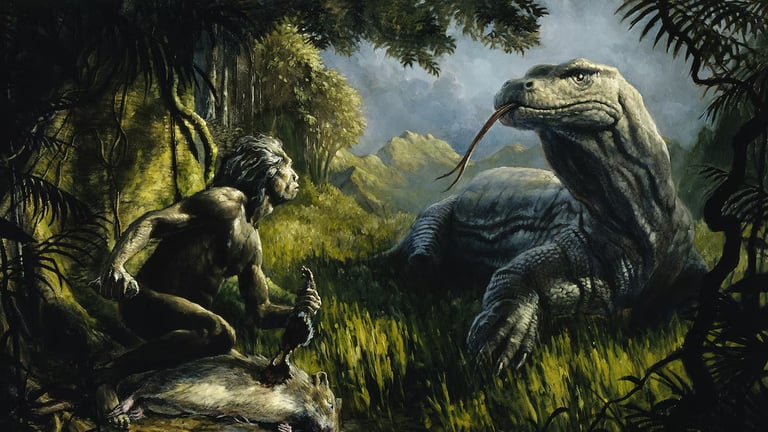

A new study challenges the view that Homo floresiensis hunted large prey or used fire, suggesting instead that they scavenged leftovers and had limited fire use.
Analysis of Stegodon bones from Liang Bua cave shows most hobbit-related marks are on less desirable cuts, implying scavenging rather than active hunting.
An experimental observation with a Komodo dragon indicates it prefers meatier carcass parts, informing interpretation of fossil marks.
The findings contribute to ongoing debates about the cognitive abilities and subsistence strategies of H. floresiensis and prompt calls for further Flores research.
Authors acknowledge that the idea of complex behavioral adaptations in H. floresiensis remains debated and that more work is needed.
Broader implication: the results emphasize non-linear human evolution and suggest H. floresiensis may have survived with different behaviors than modern humans.
Experts note the findings complicate prior views and keep open questions about the H. floresiensis lineage and its relation to other small-bodied hominins or larger ancestors like Homo erectus.
Published in Science Advances, the work reframes assumptions about hobbits’ behavioral capabilities and their relationship to other ancient humans, including whether they hunted Stegodon or used fire.
Despite revised behavior, hobbits show adaptive success, enduring nearly a million years on Flores in isolation.
The study feeds into broader questions about hobbit ancestry, potentially aligning their evolution more with Homo erectus or earlier small-bodied hominins than with a narrative of fire-using hunters.
Context: H. floresiensis disappeared around 50,000 years ago, roughly when modern humans arrived on Flores, amid contemporaneous coexistence elsewhere between Neanderthals and Homo sapiens.
H. floresiensis inhabited Flores for at least hundreds of thousands of years prior to its disappearance, overlapping with the spread of Homo sapiens in Southeast Asia.
Summary based on 5 sources
Get a daily email with more Science stories
Sources


Science • Jul 3, 2026
Our ancient ‘hobbit’ cousins ate dragon leftovers
New Scientist • Jul 2, 2026
‘Hobbit’ hominins scavenged meat left over by Komodo dragons
Scientific American • Jul 3, 2026
Ancient ‘hobbits’ feasted on Komodo dragons’ leftovers