Neuronal Migration Exposes DNA to Breaks: New Study Unravels Genome Challenges in Cerebellar Development
June 17, 2026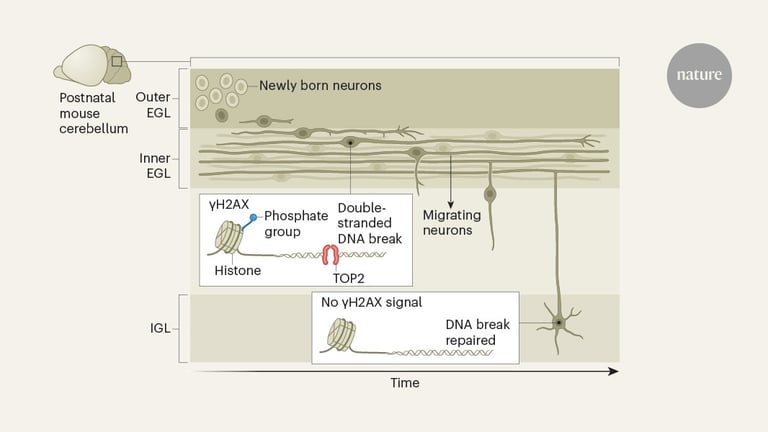

During development, migrating cerebellar granule neurons incur DNA double-strand breaks primarily from mechanical stress in confined environments rather than from replication, highlighting a migration-associated genome challenge.
Readers should consult the original Nature study and its references for detailed experimental data and broader implications.
The discussion places this finding in the context of neuroscience and genetics literature, emphasizing why DNA damage during neuronal migration matters biologically.
Conditional loss of LIG4 in postmitotic cerebellar granule neurons leads to persistent γH2AX foci, signaling unrepaired DSBs, yet this damage does not trigger obvious cell death, suggesting some tolerance to migration-related damage.
Non-homologous end joining is the primary repair pathway for these DSBs; blocking ligase IV or DNA-PK impairs repair, while RAD51-dependent homologous recombination plays a minor role.
The brain has evolved repair mechanisms to address this damage, but insufficient repair can have lasting consequences.
END-seq reveals that DSBs from confined migration are widespread, enriched in inactive chromatin and retrotransposons, with little overlap at promoters or active regulatory elements and no distinct site-specific hotspots.
TOP2β activity contributes to DSBs during confined migration, as stalled TOP2ccs trap on DNA; proteasomal degradation helps resolve these breaks.
In LIG4-deficient mice, genome-wide transcription shifts toward reduced neuronal differentiation and synaptic function while stress and immune response genes rise, though microglial activation is not observed.
The News & Views authors are experienced researchers from Boston Children's Hospital and Harvard Medical School, providing expert perspective on the study.
DSBs form in postmitotic neurons during migration without nuclear envelope rupture; NE rupture is rare and not required for DSB formation in this context.
DSBs occur as γH2AX and 53BP1 foci in migratory postmitotic neurons, with higher incidence along migratory paths than in germinal zones.
Summary based on 2 sources
Get a daily email with more Science stories
Sources
Nature • Jun 17, 2026
Confined migration induces non-lethal DNA damage in developing neurons
Nature • Jun 17, 2026
Navigating a crowded developing brain leaves neurons with broken DNA