Ctenophore Organizer Breakthrough: Revealing Deep Evolutionary Links Across Animal Kingdom
June 17, 2026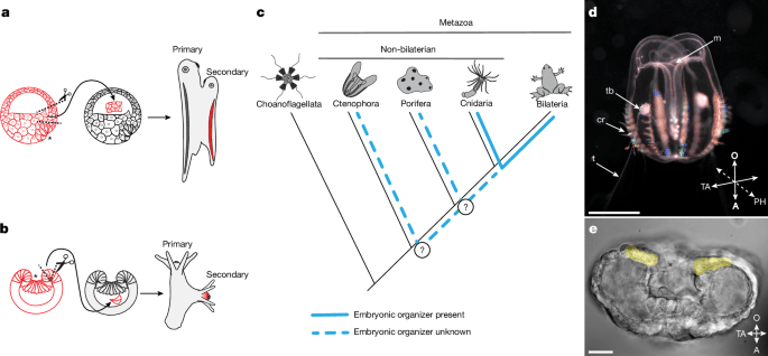

Starting with Mnemiopsis leidyi, transplant experiments reveal that its blastopore lip acts as an embryonic organizer capable of inducing a secondary pharynx and mouth, recruiting host cells into the induced structures.
When the ctenophore organizer is transplanted into the cnidarian Nematostella vectensis, it can induce ectopic oral structures, evidenced by NvFoxA activation, suggesting organizer-mediated induction can cross phyla and signaling networks are deeply conserved across Metazoa.
findings suggest WNT ligands may not be the primary inductive cues at the Mnemiopsis organizer, with maternal β-catenin activity potentially driving early signaling independently of WNT, a pattern echoed in other species.
In Nematostella vectensis, TGF-β–SMAD2/3 signalling interacts with β-catenin to regulate organizer formation and oral–aboral patterning, where inhibiting either pathway reduces blastopore lip genes and alters tissue patterning, implying a shared regulatory network across early-diverging lineages.
Overall, the results indicate a conserved network where organizer induction depends on β-catenin and TGF-β–SMAD2/3 signalling, with secreted ligands driving induction and β-catenin acting intracellularly, pointing to universal mechanisms for primary axis formation.
β-Catenin and TGF-β–SMAD2/3 signalling are essential for the ctenophore organizer’s function: inhibiting β-catenin reduces MlBrachyury and pharynx formation, activating it can cause pharyngeal overgrowth and multiple mouths, while TGF-β–SMAD2/3 is required for organizer formation and oral structures, with inhibitors diminishing secondary pharynx formation and altering gene expression.
Donor and host cells contribute variably to the induced pharynx, with donor cells often supplying axial midline tissue and surrounding regions containing donor–host mixtures; some induced structures are purely donor-derived, indicating occasional induction failure.
The study traces the embryonic organizer concept from vertebrates to cnidarians and extends the inquiry to non-bilaterians like ctenophores to understand the evolutionary origin of axis formation.
Collectively, the work provides strong evidence that embryonic organizers and their inductive signalling networks are deeply conserved across animal life, extending to non-bilaterian lineages and offering insight into the evolutionary origins of multicellularity and axis specification.
Summary based on 1 source
Get a daily email with more Science stories
Source
Nature • Jun 17, 2026
A blastoporal organizer in a ctenophore