Surprising X-ray Variability in Messier 83's Supernova Remnants Unveils New Cosmic Mysteries
June 16, 2026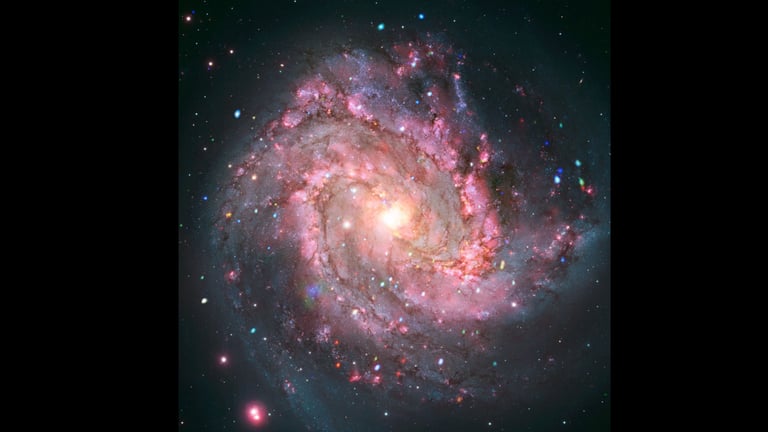

Astronomers using NASA’s Chandra X-ray Observatory observed a set of supernova remnants in the nearby spiral galaxy Messier 83 that show surprising variability in X-ray brightness over about 14 years, rather than the expected gradual fading after a explosion.
Data from Chandra, spanning roughly 2000 to 2014, reveal these atypical brightness changes among several remnants in M83.
M83 lies about 15 million light-years away and is a prolific star-forming galaxy, making it a key site for studying how supernova remnants evolve.
Researchers propose that different remnants in M83 may be driven by different mechanisms, suggesting a combined scenario.
Two possible causes are proposed for the varied X-ray emissions: surviving high-mass X-ray binary systems formed from exploded binaries, or re-accretion of expelled ejecta onto a remaining compact object like a black hole or neutron star.
A related explanation suggests surviving binary companions form systems with compact objects that accrete material, effectively recycling ejecta from the original explosion.
Lead author Andrea Prestwich notes that the distance to M83 challenges the level of observable detail, complicating definitive explanations for the variability.
Findings from M83 may apply to other star-forming galaxies, with follow-up work in M51 showing a similar population of variable X-ray sources linked to supernova remnants.
SN 1957D is currently brightening due to debris colliding with surrounding material, offering part of the explanation for the variability.
However, the debris-collision explanation for SN 1957D does not account for all variable sources observed in M83.
Overall, the study highlights unexpected variability in supernova remnants and points to new dynamics in how stellar explosions interact with their environments.
It's likely that both mechanisms are active in different remnants, contributing to the observed differences in X-ray brightness.
Summary based on 2 sources
Get a daily email with more Science stories
Sources
Scientific American • Jun 16, 2026
NASA data reveals weird x-ray changes in the exploded ruins of dead stars
Popular Science • Jun 16, 2026
‘Fireworks’ spotted in stellar explosion 15 million light-years away