Venus Flytrap's Fast Snap Explained: Cell Wall Softening, Not Water Transport, Drives Closure
June 12, 2026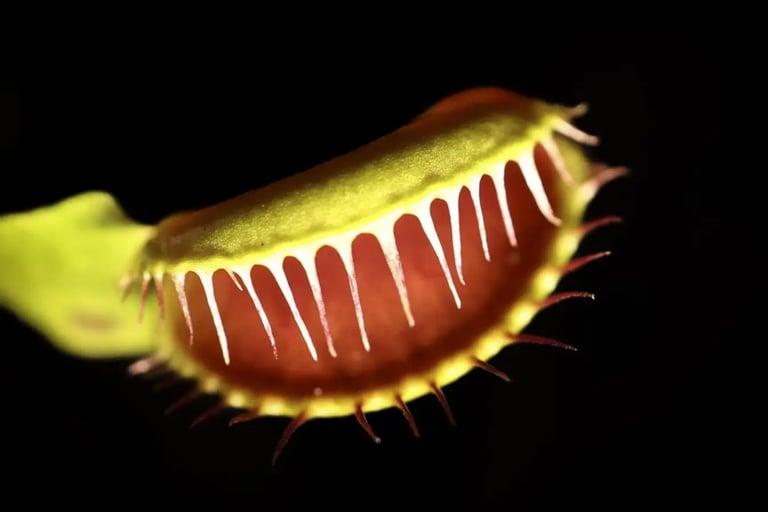

Touching the trigger hairs twice in quick succession causes the trap to snap shut, a mechanism under study to understand prey capture.
A new Science study upends the water-transport idea and shows Venus flytraps close thanks to rapid outer epidermal cell-wall softening, a mechanism backed by direct measurements but still leaving some molecular details unresolved.
The trap’s snap is likened to a dome-shaped rubber popper flipping due to surface mechanics, illustrating a plant-level rapid mechanical transformation.
Using dental glue to immobilize the trap and a nanoindenter to test stiffness revealed immediate softening of the outer surface after activation, pointing to cell flexibility rather than water deflation as the trigger.
An electrical signal and calcium wave propagate across the trap within a fraction of a second, coordinating the rapid response.
Empirical observations show rapid early-cell-wall relaxation during closure, ruling out water-driven mechanics as the primary driver.
Experts view the finding as a major advance in plant biomechanics with potential applications in designing soft robots that respond to stiffness changes.
This work could inspire soft-robotics designs where changing material stiffness drives fast, autonomous movements.
The study identifies cell softening as the key mechanism behind the trap’s speed, a rapid process not previously observed at such timescales in plants.
Historical context notes Darwin praising the Venus flytrap and earlier work showing electrical impulses trigger the trap when trigger hairs are stimulated.
The new evidence contrasts prior ideas of rapid strain release or water movement, providing direct support for rapid outer-cell-wall softening as the driver.
The trigger hairs initiate an electrical signal coordinating closure within about a tenth of a second, while the mechanical change in leaf cells enables a one-second snap.
Summary based on 4 sources
Get a daily email with more Science stories
Sources

Gizmodo • Jun 12, 2026
Scientists Finally Solved the Mystery of How Venus Flytraps Snap Shut
The Guardian • Jun 11, 2026
Scientists reveal surprising mechanism behind Venus flytrap’s rapid snap
Nature • Jun 11, 2026
Revealed: how Venus flytraps snap shut with astonishing speed
New Scientist • Jun 11, 2026
Have we finally worked out how Venus flytraps snap shut?