JWST Unveils Farthest Dormant Black Hole, Weighing 6 Billion Suns in Ancient Galaxy
June 5, 2026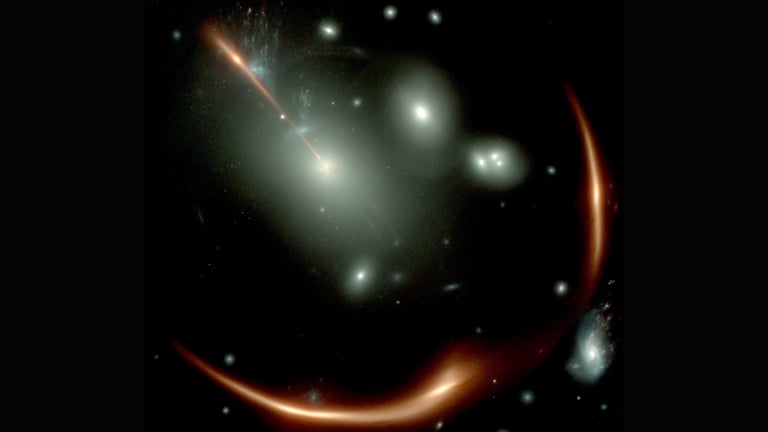

Using gravitational lensing to magnify a distant, quiescent galaxy, researchers employed integral field spectroscopy with JWST to map stellar motions and resolve the black hole’s sphere of influence, enabling a direct dynamical mass measurement.
The James Webb Space Telescope, coupled with stellar dynamics and lensing, provided the data needed to weigh the dormant black hole in this galaxy.
Observations with JWST mapped stellar velocities through integral field spectroscopy, constraining the black hole’s gravitational influence in the distant galaxy.
The result adds a pivotal data point for understanding how black hole masses scale with their host galaxies across cosmic history.
The dormant black hole weighs about six billion solar masses in a galaxy whose stars are largely absent, indicating a quiescent system that may have hosted a quasar in the past.
The measured mass aligns with one local black hole–bulge relation but conflicts with another, underscoring ongoing questions about black hole–galaxy co-evolution at high redshift.
Researchers advocate applying this dynamical, lens-assisted method to more distant galaxies to build a larger census of black hole growth and its role in galaxy evolution.
This observation offers a rare window into the early universe (roughly three billion years after the Big Bang) and demonstrates a viable technique for weighing black holes in distant galaxies.
Led by Andrew B. Newman, the team measured the mass of the inactive supermassive black hole in galaxy MRG-M0138 at redshift 1.95, about ten billion years ago.
MRG-M0138 hosts a dormant black hole that is the farthest of its kind observed to date, lying over 10 billion light-years away.
The inferred mass is 6.0 minus 1.7 plus 2.1 times 10^9 solar masses, with asymmetric uncertainties.
This work highlights the importance of direct dynamical mass measurements for testing how black hole growth tracks host galaxy properties over cosmic time.
Summary based on 2 sources
Get a daily email with more Science stories
Sources
Quantum Zeitgeist • Jun 6, 2026
Galaxy Lens Shares Black Hole Mass At Redshift 2
Popular Science • Jun 5, 2026
JWST spots dormant black hole 10 billion light-years from Earth