Jupiter's Foreshock Accelerates Electrons to Near-Light Speeds, Challenging Traditional Theories
June 3, 2026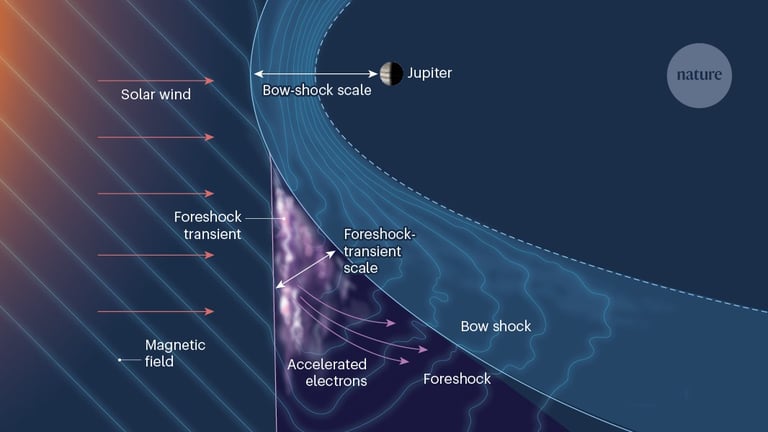


A Nature study finds electrons in Jupiter’s foreshock accelerate to near-relativistic speeds, showing that upstream, naturally occurring particle-accelerating structures can outperform traditional shock boundary acceleration.
Direct Juno observations reveal relativistic (>1 MeV) electrons upstream of Jupiter’s bow shock, tied to a specific foreshock transient.
Future work should apply the scaling to additional astrophysical shocks and refine models with more complex three-dimensional foreshock dynamics.
The approach creates a cross-disciplinary framework between heliophysics and astrophysics to estimate cosmic-ray upper limits based on global shock geometry and upstream conditions.
A unifying model links the maximum energy of accelerated particles to the shock’s spatial scale, challenging conventional acceleration theories.
Experts identify three pillars: shared collisionless-shock physics, similar environmental factors, and the greater capacity of astrophysical shocks to sustain large, transient structures driving acceleration.
An empirical scaling from Solar System observations connects L to S, yielding Emax predictions for Earth, Jupiter, Saturn, and extending to protostellar jets and certain supernova remnants.
The work shifts from a local DSA picture to acceleration along extended foreshock regions and transients, using Bohm diffusion for conservative bounds.
The proposed model could explain observations across planetary, galactic, and extragalactic shocks via a common scaling principle.
Findings generalize Earth’s mechanism, suggesting the same physics governs particle acceleration in extreme cosmic environments beyond our solar system.
The research by Raptis et al. in Nature builds on earlier shock-acceleration ideas from Hillas, Blandford & Ostriker, and Drury.
Collisionless shocks in space—where solar wind meets planetary magnetic fields—energize particles through repeated interactions in bow shocks and foreshocks, not just at the boundary.
Summary based on 3 sources
Get a daily email with more Tech stories
Sources
Gizmodo • Jun 3, 2026
Jupiter Flings Particles to Nearly the Speed of Light. The Weird Part Is How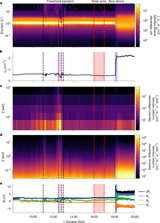
Nature • Jun 3, 2026
Relativistic electron acceleration at the bow shock of Jupiter and beyond
Nature • Jun 3, 2026
Jupiter observations reveal a simple scaling law for particle acceleration