Breakthrough in Physics: 2D KPZ Universality Confirmed with Polariton Experiments at Near Absolute Zero
May 7, 2026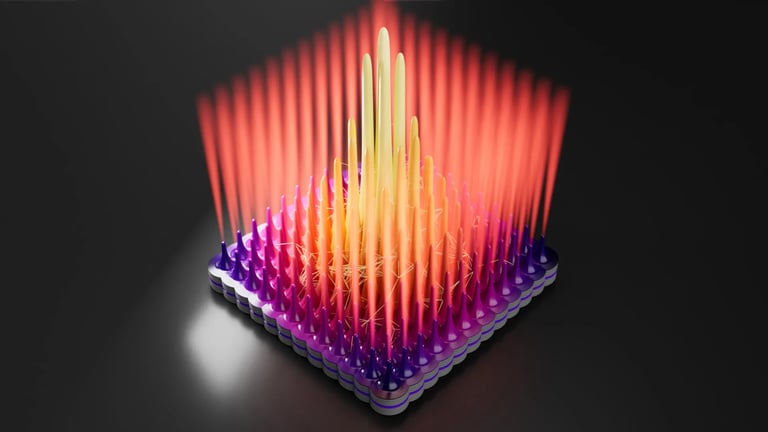

Polaritons are pumped with laser light and their spatial and temporal evolution is tracked, showing that the growth process belongs to the two-dimensional KPZ universality class, providing strong evidence of the model's universality in non-equilibrium systems.
The experimental setup relies on precision materials design, including molecular beam epitaxy to fabricate highly reflective mirror layers that trap photons in a central quantum film, enabling strong light-matter interactions and controllable growth dynamics.
Experiments are conducted at ultra-low temperatures near absolute zero and with micrometer-scale laser excitation, ensuring non-equilibrium dynamics align with KPZ predictions.
Researchers at the University of Würzburg use a gallium arsenide semiconductor to create polaritons—hybrid light–matter particles that form and decay within a few picoseconds—to study surface growth dynamics.
The Kardar-Parisi-Zhang (KPZ) equation, foundational for growth in diverse systems, has now been experimentally confirmed in two dimensions for the first time, extending prior one-dimensional validation from Paris in 2022.
Demonstrating KPZ universality in two-dimensional material systems reinforces the equation’s fundamental role in describing real non-equilibrium growth across physical contexts.
The theoretical groundwork for testing KPZ universality in such systems was proposed by Sebastian Diehl in 2015, with earlier 1D experiments by Paris researchers in 2022; Würzburg completes the two-dimensional validation.
Summary based on 1 source
Get a daily email with more Science stories
Source

ScienceDaily • May 6, 2026
Scientists finally solve 40-year-old physics puzzle about how things grow