Dual Nature of Electrons in Magic-Angle Graphene: Heavy and Light Particles Unveiled
May 6, 2026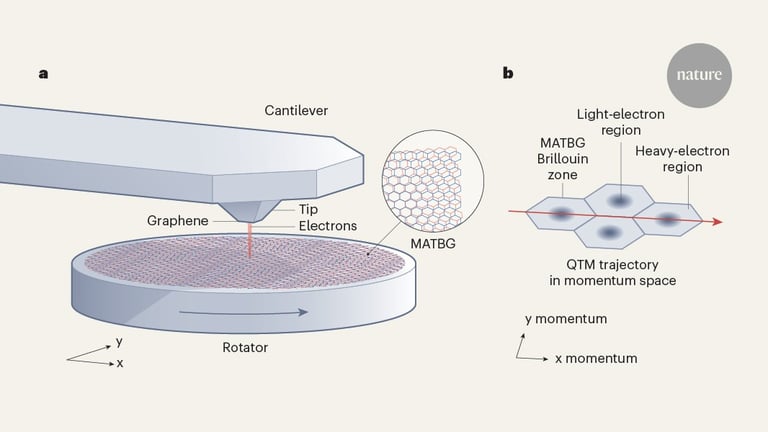

Intro: In magic-angle twisted bilayer graphene, electrons behave as both heavy and light particles depending on momentum, challenging the notion that all electrons in the flat bands are uniformly heavy.
New finding: Nature reports that electron effective mass in MATBG is momentum-dependent, yielding heavy, strongly interacting electrons in some momenta and light, mobile electrons in others.
The study uses high-resolution momentum-space imaging via quantum twisting microscopy to map interacting energy bands at 4 K, revealing a dual electronic character where most states are heavy and localized, but a small region near the Gamma point hosts light, delocalized electrons, coexisting within the same flat bands.
Access and citation info: The News & Views piece appears in Nature in 2026, with references to related articles and a list of supporting citations for further reading.
An unresolved feature persists: a ~15 meV excitation for holes (opposite for electrons) within the flat-band region that remains constant with filling, hinting at an additional degree of freedom not captured by current models.
Away from the magic angle, bands align with the Bistritzer–MacDonald model featuring Dirac points at mini-Brillouin zone corners and a Gamma-point band maximum width; at the magic angle, interactions flatten and largely gap the bands except near Gamma where bands stay dispersive and gapless, suggesting c-like light electrons.
Spectral-weight analysis indicates at the magic angle the best match for w0/w1 is about 0.6, constraining interlayer coupling and moiré structure.
A key mechanism is Hartree-driven band stretching: increasing filling causes AA-localized flat-band states to accumulate charge, shifting the Gamma-point states less than the flat-band states and creating momentum-space differentiation.
Filling-dependent spectroscopy shows cascade-like spectral shifts across integer fillings for flat-band states, while Gamma-point states show a non-cascading peak near EF that evolves with filling, aligning with inverse compressibility and supporting the c-like and f-like dichotomy.
References and related work: The article places the findings in the broader context of magic-angle graphene studies, citing prior foundational work and recent papers by Xiao and colleagues.
A simple toy model captures Dirac-like light electrons near Gamma and heavy flat electrons elsewhere, illustrating Dirac revivals from competition between Coulomb interactions and Hartree shifts without invoking direct c–f hybridization.
The carrier-density evolution suggests Mott-like cascades of heavy electrons and Dirac-like light-electron compressibility, with charge redistribution between light and heavy states underpinning Dirac revivals observed in compressibility measurements.
Summary based on 2 sources
Get a daily email with more Science stories
Sources
Nature • May 6, 2026
Imaging the flat bands of magic-angle graphene reshaped by interactions
Nature • May 6, 2026
In twisted graphene, some electrons are heavier than others