Magnetic Fluctuations: The Key to UTe2's Unconventional Superconductivity?
April 29, 2026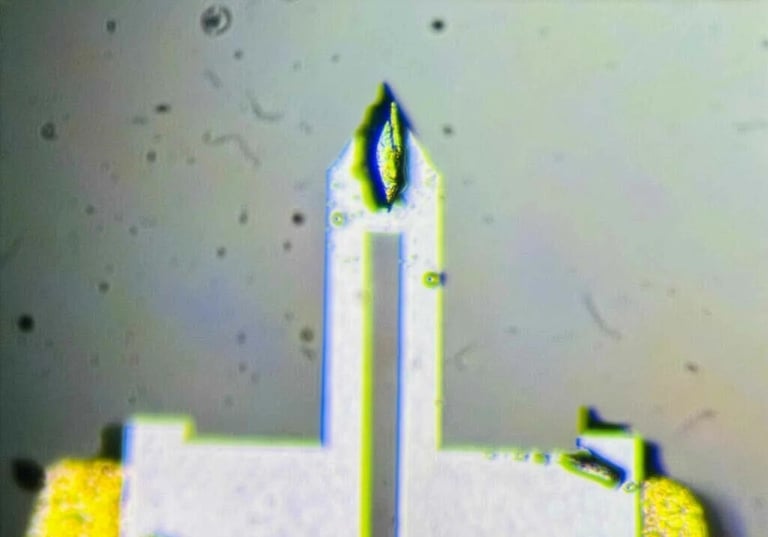

The study argues that magnetic fluctuations, not magnetism itself, may underpin UTe2’s reentrant superconductivity, suggesting a mechanism for its unconventional behavior rather than traditional magnetic ordering.
Like other uranium-based superconductors, UCoGe and URhGe show reentrant superconductivity and magnetism, but UTe2’s non-magnetic nature and directional dependence make its mechanism particularly enigmatic.
The work proposes that magnetic fluctuations could drive the high-field superconductivity in UTe2, offering a plausible mechanism beyond electron-phonon pairing typical of conventional superconductors.
The new high-field measurement method enables experiments on ultra-small samples and is being adopted by laboratories worldwide, broadening the toolkit for studying quantum materials in extreme conditions.
In pulsed fields up to 60 Tesla, rapid field ramps reveal a large transverse magnetic susceptibility region that helps bind electrons under extreme conditions.
Researchers detected a region of strong transverse magnetic fluctuations near the onset of reentrant superconductivity, which they describe as the possible “glue” binding electrons under high fields.
A novel measurement approach developed at ISTA uses a cantilever to probe transverse magnetic susceptibility in tiny, defect-free UTe2 samples within pulsed fields, enabling rapid magnetization assessment.
The technique exploits rapid field changes in pulsed magnets to study how transverse magnetic susceptibility responds in extremely small crystals.
The findings, published in Nature Astronomy on April 29, 2026, point to a potentially new type of superconductivity with broad implications, though practical applications remain speculative.
Overall, the results contribute to the broader understanding of quantum materials by highlighting magnetic fluctuations as a potential driver of superconductivity, a concept of interest for future fundamental science and possible future applications.
UTe2, a uranium ditelluride superconductor, exhibits reentrant superconductivity, losing its superconducting state around 10 Tesla but regaining it between roughly 40 and 70 Tesla under certain field directions.
Thus, UTe2 is an unconventional superconductor with mysterious reentrant behavior, where zero resistance reappears at very high magnetic fields after initial superconductivity is suppressed.
Summary based on 2 sources
Get a daily email with more Science stories
Sources

The Debrief • Apr 29, 2026
“It’s a Mystery”: This Strange Superconductor Exhibits Odd Behavior Under Extreme Conditions
EurekAlert! • Apr 29, 2026
Superconductivity that shouldn’t exist?