New Model Reveals Climate-Induced Soil Carbon Losses Across China by 2100
April 23, 2026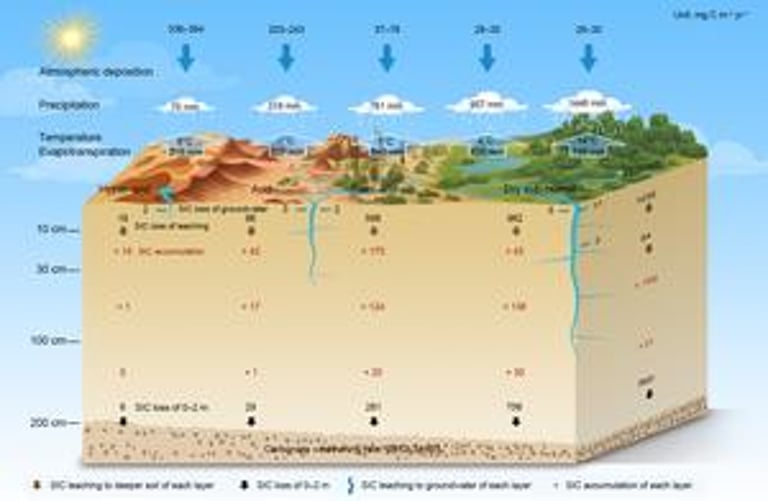

A new mechanistic framework, SINOCOM, links climate, hydrology, and carbonate chemistry to soil inorganic carbon (SIC) redistribution, enabling improved predictions of SIC dynamics under climate change and highlighting SIC vulnerability to temperature, precipitation, and hydrological processes.
Approximately 1% of topsoil SIC is lost laterally to groundwater, about 29–31% leaches to deeper layers (10–200 cm), and 68–70% leaches out of the 200 cm layer, representing vertical translocation.
In semi-arid regions of China, SIC losses are projected to be the largest, around 124 Tg C (10.5%), with humid regions at 107 Tg C (51.7%), dry sub-humid at 63 Tg C (40.0%), and arid and hyper-arid regions far lower.
Globally, SIC (primarily CaCO3) is a dominant carbon pool, with about 2,305 petagrams of carbon stored in the top 2 meters of soil, traditionally viewed as geochemically stable over millennia.
Seasonality strongly governs SIC dynamics: warm-season rainfall in arid climates drives 68% of mean annual SIC input and 85% of mean annual SIC loss, while intense seasonal precipitation dominates 76–81% of annual SIC loss under humid conditions, indicating that mean annual precipitation alone underestimates fluxes.
A Chinese team led by Ganlin Zhang developed SINOCOM, a process-based model with 10 cm vertical resolution to quantify climate-change effects on soil inorganic carbon dynamics across China for 2015–2100.
From 2015 to 2100, under four SSP scenarios, total SIC in the top 2 meters is projected to decline by 307–321 Tg, and total SIC in the top 0–10 cm is projected to decline by 307–321 Tg, reflecting substantial topsoil losses.
SINOCOM integrates a soil water balance module with carbonate geochemical equilibrium to simulate climate-driven SIC changes while excluding acidification processes to isolate climate effects.
Summary based on 1 source
Get a daily email with more Science stories
Source
EurekAlert! • Apr 23, 2026
Climate change leads to significant loss of soil inorganic carbon