New Study Challenges Early Solar System Mineral Formation Theories with Non-Equilibrium Condensation Insights
April 22, 2026

The study analyzes how different modes of solar nebula accretion and rapid cooling shape where Type A, B, and C minerals form, with gaps in the disk potentially preserving distinct precursor reservoirs and aligning with the early solar system’s NC and CC separations.
Apparent fO2 estimates show that while equilibrium fO2 values for the three mineral types span chondrite-like ranges, the actual gas remains highly reducing across most of the temperature range, highlighting strong disequilibrium.
Researchers frame the work as a paradigm shift, emphasizing ongoing exploration rather than a final answer about early solar-system processes.
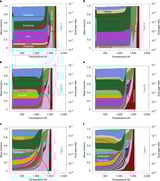
Under fast-cooling, low-pressure conditions, mineralogy becomes richer below 1,000 K, with iron in multiple oxidation states, hydrated minerals, and CAI-related phases; water ice condenses only in Types A and B.
Kinetic condensation can explain some chondrule precursor features, but full chondrule chemistry likely requires melting, recycling, and aqueous alteration, while primary amorphous silicates remain difficult to constrain.
Activation energy variations have little impact on final mineralogy; condensation kinetics depend more on the availability of supersaturated species.
Non-equilibrium (kinetic) condensation differs from equilibrium condensation, with KCS resembling ECS at long cooling times and higher pressures but diverging at low temperatures to preserve CAI-like minerals and suppress late-stage plagioclase.
In the Urey–Craig framework, final condensates cluster along the solar Fe/Si line, reproducing broad redox trends of several chondrite classes but missing some subgroups due to missing physics like gas–solid sorting or open-system effects.
Oxygen variability emerges as a key driver of mineral oxidation states, helping reproduce the three chondrite families and signaling oxidation’s central role in early solar-system chemistry.
If validated, the model could reshape ideas aboutwater delivery and hydrated minerals, suggesting Earth-like planets might acquire water earlier rather than solely through late delivery.
The study offers a conceptual framework where non-equilibrium condensation accounts for redox diversity and the first-order split among chondrite types, while noting missing physics and the need for further work.
Fast cooling prevents full equilibration, allowing gas-trapped elements to form multiple minerals simultaneously and creating a diverse mineralogy rather than a single sequence.
Summary based on 2 sources
Get a daily email with more Science stories
Sources
Nature • Apr 22, 2026
Non-equilibrium condensation of the first Solar System solids
Scientific American • Apr 22, 2026
The solar system’s first solids had a fast start