Caspase-5c: A New Player in Gut Health and Tissue Repair Through Wnt Pathway Activation
April 22, 2026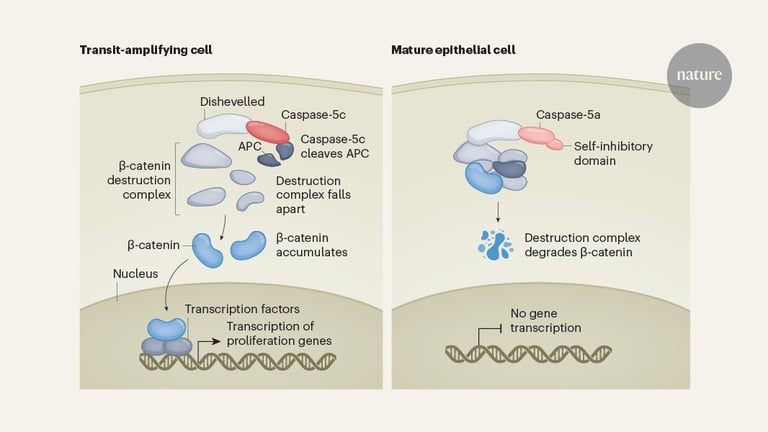

A new study shows Caspase-5c enhances Wnt signaling by cleaving APC, a mechanism that promotes intestinal homeostasis and tissue repair.
The research links caspase-5–mediated activity to Wnt pathway modulation through APC cleavage, suggesting a role in tissue maintenance and healing in the gut.
Using computational analyses alongside literature-backed experiments, the work establishes a connection between Caspase-5c activity, APC cleavage, Wnt signaling, and intestinal homeostasis.
Public data and source materials underpin the study are openly available in listed repositories and figure URLs to ensure transparency and reproducibility.
The study integrates multi-omics datasets—single-cell and bulk RNA sequencing, methylation, and proteomics—from diverse sources like SCP259, Gut Cell Atlas, TCGA, cBioPortal, and UniProt.
Beyond basic science, the article notes potential clinical relevance and therapeutic angles for gut diseases, while acknowledging the need for further validation.
The references place the work in a broader context of caspases, the Wnt pathway, organoid models, inflammatory signaling, and intestinal biology.
Detailed data processing and analysis code are described in the Methods and are accessible through the article’s Sec12 reference.
A News & Views feature discusses Jia et al.’s Nature paper, highlighting caspase-5’s role in intestinal repair with possible implications for inflammatory bowel disease and colorectal cancer.
Caspase-5, traditionally tied to cell death, is shown to promote proliferation in immature gut cells, aiding tissue regeneration.
The piece frames caspase-5 as part of the broader caspase family with non-death functions that contribute to gut homeostasis and regeneration.
Summary based on 2 sources
Get a daily email with more Science stories
Sources
Nature • Apr 22, 2026
Caspase 5c amplifies Wnt via APC cleavage to promote intestinal homeostasis
Nature • Apr 22, 2026
A cell-death protein has an unexpected role in intestinal repair