NASA Powers Down Voyager 1 Instrument to Conserve Energy for Interstellar Exploration
April 20, 2026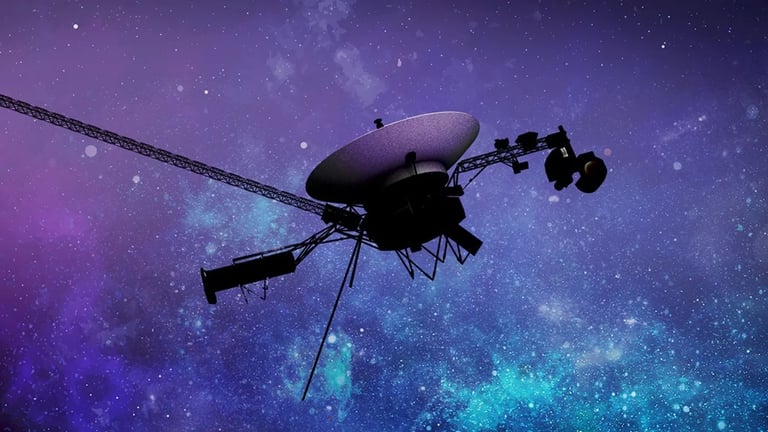


NASA has shut down the Low-Energy Charged Particles (LECP) instrument on Voyager 1 to conserve power and extend its life as it travels in interstellar space.
A power-management plan nicknamed the Big Bang will optimize energy use for both Voyager 1 and Voyager 2 and will be tested on Voyager 2 next month.
Two other active instruments—the plasma-wave sensor and the magnetic-field experiment—remain powered as mission teams work to keep the spacecraft operational for as long as possible.
Although designed with identical instrument suites, only a subset remains functional on both Voyagers, limiting data from the edge of the solar system.
LECP has been measuring low-energy ions, electrons, and cosmic rays since Voyager 1’s 1977 launch.
The shutdown occurred Friday, April 17, to conserve dwindling nuclear power for continued data collection beyond the solar system.
With energy reserves dwindling, Voyager 1 has halted one of its remaining three science instruments to conserve power.
A small motor on LECP remains powered to periodically scan in all directions, preserving a path to potential future reactivation.
Voyager 1 and Voyager 2 continue to play a crucial role in studying the interstellar medium as they transmit data from beyond the solar system.
The mission adapts to aging hardware while pursuing data from a region no other human-made craft has explored.
Launched in 1977, Voyager 1 is the farthest human-made object, roughly 15.8 billion miles from Earth, and has surpassed its original five-year mission.
Voyager 1 remains the most distant object from Earth, moving at about 51,000 miles per hour and having entered interstellar space in 2012.
Summary based on 3 sources
Get a daily email with more Tech stories
Sources
Gizmodo • Apr 20, 2026
NASA Shut Down Voyager 1 Science Instrument After Unexpected Power Drop
Space • Apr 20, 2026
NASA shuts down Voyager 1 instrument to keep probe exploring interstellar space
Scientific American • Apr 20, 2026
NASA’s Voyager 1 spacecraft down to just two working science instruments