Study Reveals Ancient Weathering's Role in Sparking Ice Age, Offers Insights for Future Climate
April 20, 2026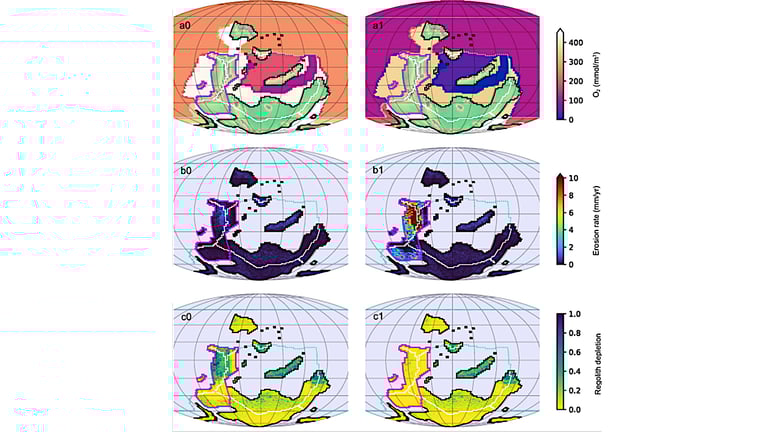

A new study tests the idea that intensified continental silicate weathering drove CO2 removal and sparked glaciation, using lithium isotope proxies alongside Earth-system models COPSE and GEOCLIM.
Collaborators span multiple institutions, including Aix-Marseille University, China University of Geosciences (Wuhan), Université Bourgogne, University of New Mexico, Johannes Gutenberg University, University of Victoria, and various other international researchers.
Led by Feifei Zhang at Nanjing University, the team investigates what triggered the Late Paleozoic transition from a greenhouse to an icehouse climate roughly 350 million years ago, with implications for current and future climate understanding.
The research underscores the long-term importance of weathering processes for climate dynamics and their relevance to forecasting future CO2 removal, ocean biogeochemical responses, and ecosystem resilience under sustained forcing.
Scientists studied Late Paleozoic marine carbonate rocks aged about 359 to 347 million years from Montana and Nevada, capturing a major positive carbonate carbon-isotope excursion that may mark the onset of the ice age.
Funding came from the National Natural Science Foundation of China and ANR projects RISE and CYCLO-SED, with results published in an open-access issue of National Science Review.
Laboratory measurements reveal a ~12 per mil drop in lithium isotopes, signaling roughly a 30% rise in continental silicate weathering, which could lower atmospheric CO2 from ~1000 ppm toward 200 ± 200 ppm and boost marine productivity.
The inferred weathering intensification supports a weathering–carbon cycle feedback as a driver of the Late Paleozoic climate transition toward glaciation.
Summary based on 1 source