Breakthrough in Light Manipulation: Stable Optical Vortex Achieved with Liquid Crystal Torons
April 11, 2026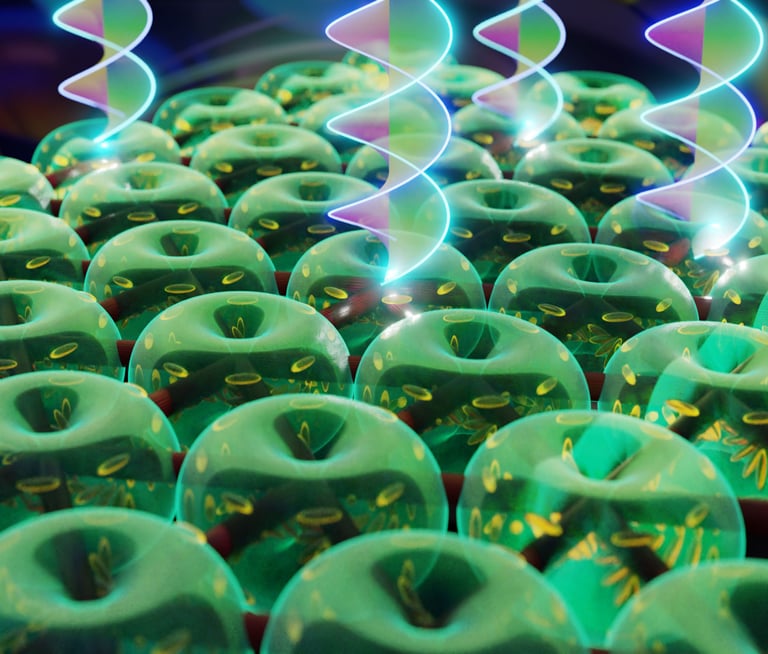

Researchers demonstrated stable optical vortex light in its ground state by embedding liquid crystal torons in a high-quality optical microcavity, paving the way for compact light sources with intricate internal patterns.
This behavior suggests photons take on quark-like characteristics within a vectorial charge framework, offering a novel method to manipulate light without relying on complex nanofabrication.
Confinement in the microcavity strengthens light–toron interactions and enables control over trap size and light properties through an external electric voltage.
The approach could yield simpler, scalable photonic devices and more compact light sources for optical communications and quantum technologies, shifting away from intricate nanoscale fabrication toward self-organized materials.
The study, titled Ground-state orbital angular momentum lasing from liquid crystal torons embedded in a microcavity, appeared in Science Advances on March 13, 2026, with collaborators from the University of Warsaw, Military University of Technology, and Institut Pascal CNRS, among others, supported by Polish funding and Horizon 2020.
For the first time, optical orbital angular momentum in the ground state was achieved, yielding stable, low-loss, lasing-capable vortex light that is coherent and directional.
The setup uses self-organizing liquid crystals to create torons—tight spiral defects that trap light and generate a synthetic magnetic field for photons via spatially varying birefringence.
Summary based on 1 source
Get a daily email with more Science stories
Source

SciTechDaily • Apr 11, 2026
Scientists Create “Optical Tornadoes” That Twist Light Into a Swirling Vortex