CMS Achieves Most Precise W Boson Mass Measurement, Aligns with Standard Model, Challenges CDF Anomaly
April 8, 2026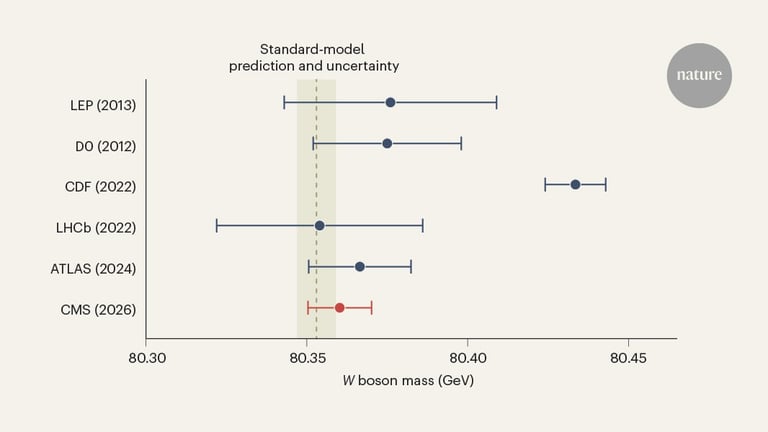

CMS reports the most precise W boson mass measurement to date, determined from 13 TeV proton–proton collisions at the LHC using over 100 million W→μν decays.
The measured W mass is 80,360.2 ± 9.9 MeV, aligning with the Standard Model and contrasting with the earlier heavier result from Fermilab's CDF.
The analysis is conducted within a blinded framework, using a running-width scheme for vector-boson masses and a three-dimensional binned likelihood fit to muon pT, pseudorapidity, and charge to extract mW.
Key methodological elements include detailed simulations of collisions, detector effects, and W production dynamics to isolate the mass from confounding factors like boson recoil and experimental uncertainties.
Systematic uncertainties are meticulously controlled, with hadronic recoil calibrated via Z→μμ events, pileup modeling, and hadronic activity; the dominant uncertainties arise from muon momentum scale/resolution and PDFs.
Backgrounds mainly come from nonprompt muons and Z→μμ with one muon outside acceptance; the nonprompt background is estimated with an extended ABCD method and contributes a small quantified uncertainty.
Z validation measurements and a W-like mZ test using a single muon are performed to test methodological robustness.
The project is supported by the U.S. Department of Energy and MIT’s SubMIT computing facility, illustrating broad international collaboration behind the measurement.
The result demonstrates the synergy of experimental innovation and theoretical modeling, leveraging CMS detector capabilities and advanced computation to test fundamental physics.
State-of-the-art predictions (N3LL+NNLO) with SCETLIB corrections and in-situ W pT profiling are used, treating PDFs and perturbative uncertainties with dedicated nuisance parameters and alternative PDF sets.
The measurement is consistent with the Standard Model, reducing tension with global electroweak fits and challenging the earlier CDF anomaly.
MIT-led researchers highlight the result as a validation of the Standard Model while signaling the ongoing pursuit of higher precision in future runs and potential new physics.
Summary based on 3 sources
Get a daily email with more Science stories
Sources
Nature • Apr 8, 2026
High-precision measurement of the W boson mass with the CMS experiment

BIOENGINEER.ORG • Apr 8, 2026
Physicists Pinpoint Precise Mass of Fundamental W Boson Particle