Toltec Altar Discovery Reveals Ritual Practices and Complex Urban Layout in Ancient Tula
March 25, 2026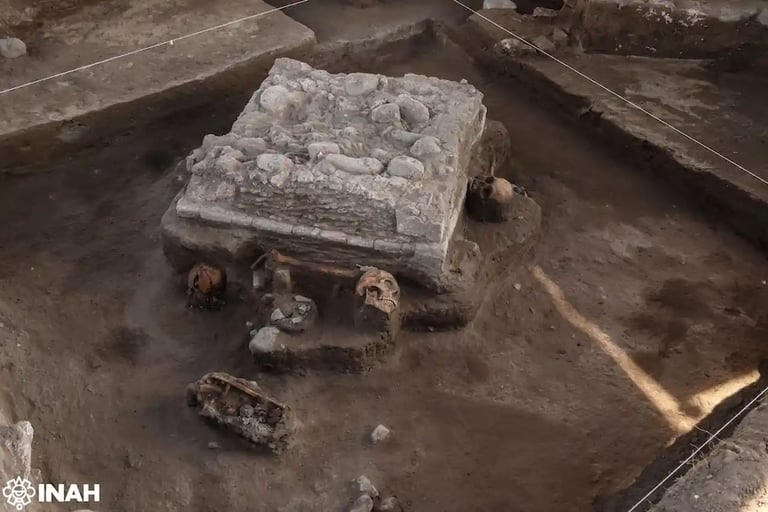

A Toltec ceremonial altar (momoztli) near Tula Chico in Hidalgo yielded human remains, including four skulls and long bones, surrounded by offerings such as ceramic vessels, obsidian blades, bone tools, shell remains, spindle whorls, and awls, indicating ritual decapitation and offerings.
Excavation began from a compacted surface in a 1-square-meter pit and expanded to reveal corner edges and three sides of the lower level packed with offerings, with potential remains on the fourth side as digging continues.
Stratigraphic evidence places the altar in a central courtyard within a high-status residential or elite area, suggesting social differentiation in Toltec urban space.
The find points to a more complex urban layout in Tula, with elite residential or ceremonial zones extending beyond previous maps, reinforcing a socially stratified city plan.
Field documentation is underway, including drawings and drone imagery, while vessels are slated for analysis in Tepeji del Río de Ocampo and the altar may be conserved in situ or protected as required.
Researchers are cataloging all materials for laboratory analysis to determine age, health, and potential causes of death, with ceramic artifacts being classified and conserved, and drone-based site modeling guiding decisions on preservation versus relocation.
Mexico’s Minister of Culture highlighted the significance of the Toltec find for understanding history and safeguarding cultural heritage, underscoring archaeology’s role in connecting past and present.
Preventive salvage work tied to the Mexico City–Querétaro rail project uncovered the momoztli near the Toltec capital’s periphery, dating to the Tollan phase between AD 900 and 1150.
Archaeologists identified the altar near Tula Chico within the Archaeological Monuments Zone of Hidalgo and linked it to ritual practices and the city’s urban layout during the Tollan period.
The rail-related salvage operation contributed a clearer picture of the city’s boundary and ritual landscape, including skulls and bone offerings in the monument’s vicinity.
Additional finds such as spindle whorls, bone tools, lithics, and mollusk remains will be studied to deepen understanding of daily life, ritual activity, and urban configuration during Tula’s peak.
Wall remains and a central courtyard layout suggest the altar was at the heart of an elite area, with a digital plan and drone imagery in progress, and artifacts including ceramics and blades undergoing further analysis.
Summary based on 3 sources
Get a daily email with more Science stories
Sources
GreekReporter.com • Mar 25, 2026
Altar With Skulls and Offerings Discovered in Ancient Capital of Toltecs
La Brújula Verde • Mar 25, 2026
Altar with offerings including skulls and bones discovered in Tula, the ancient capital of the Toltecs
Arkeonews • Mar 26, 2026
Ancient Toltec Altar with Human Remains Discovered Near Mexico’s Tula Ruins