New Brain Atlas Reveals Lifelong Evolution of Functional Connectivity Patterns
March 25, 2026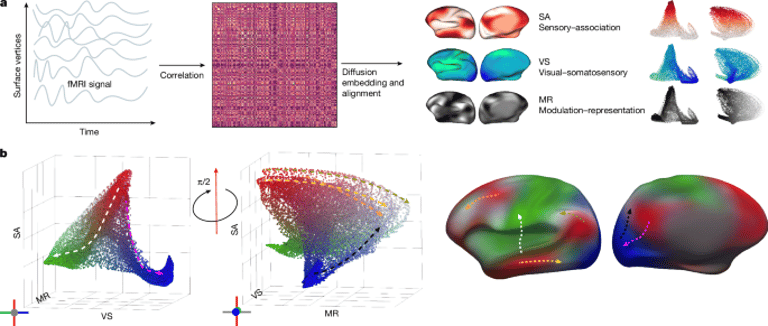

A continuous lifespan atlas maps how functional connectivity patterns in the human brain evolve from birth to old age, revealing three fundamental axes of brain organization that emerge, mature, and decline over the lifespan.
The study models three dominant gradients—sensory–association (SA), visual–somatosensory (VS), and modulation–representation (MR)—and shows how they develop and reorganize from birth through old age across the lifespan.
These axes describe how brain regions coordinate, including a sensory-to-association axis and a continuum from sensory processing to higher-order thought, with transition zones bridging the ends of the axes.
Readers are directed to related articles and the primary research article for deeper details, with access options and DOIs provided.
The research was led by Patrick Taylor and Pew-Thian Yap at the University of North Carolina at Chapel Hill, with collaborators including Jakob Seidlitz, and the findings were published in Nature.
Taylor et al. in Nature (2026) provide the core chart of functional axes and situate it within the broader context of neurodevelopmental research.
The MR gradient matures gradually, with modulation and representation poles sharpening during childhood and refining into early adulthood, indicating extended development of control and attention networks.
One author discloses competing interests related to Centile Bioscience Inc.
Structure–function coupling between microstructure and functional gradients is modest and axis-dependent, strongest for SA, and declines nonlinearly with age as functional organization becomes less tightly bound to microstructure in later life.
The VS axis differentiates visual and somatomotor systems and remains relatively stable across life, peaking in early childhood and contracting thereafter as modality segregation gives way to maturation.
The study fills a gap by tracking how all three major functional axes evolve across the entire lifespan, something not previously achieved.
The new chart builds on structural maturation knowledge and extends it to functional organization across the lifespan.
Summary based on 3 sources
Get a daily email with more Science stories
Sources
Nature • Mar 25, 2026
Functional hierarchy of the human neocortex across the lifespan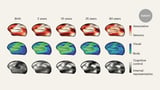
Nature • Mar 25, 2026
Charting the human brain’s lifelong functional organization
Nature • Mar 25, 2026
First atlas of brain organization shows development over a lifetime