CERN's LHCb Discovers New Heavy Baryon, Xi-cc-plus, Amid UK Funding Cuts
March 17, 2026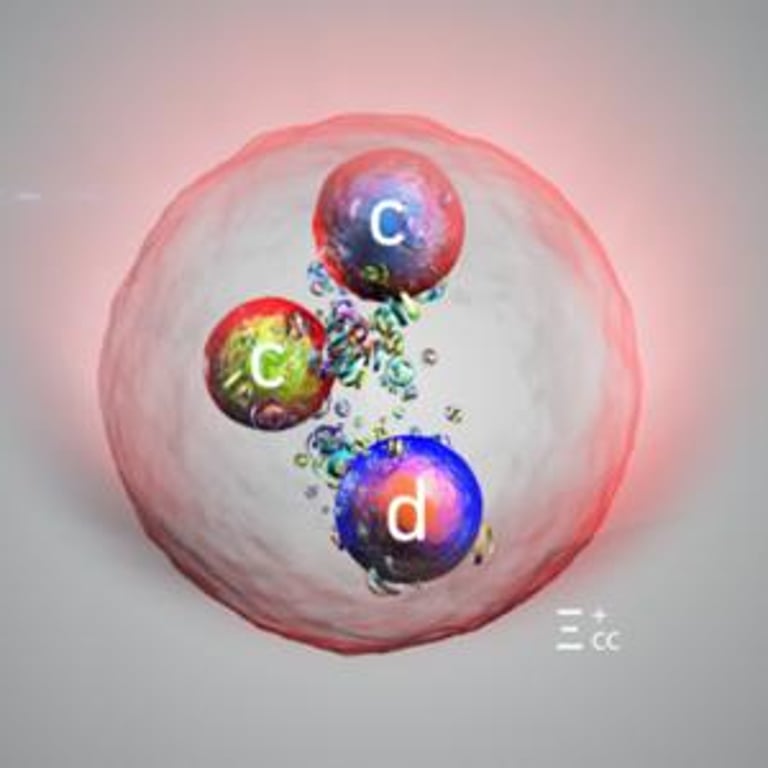


A proton-like baryon called Xi-cc-plus, composed of two charm quarks and one down quark, was discovered at CERN’s LHC by the LHCb experiment, and it is heavier than the proton.
The observation tests theories about the strong force and baryon structure and adds a new heavy-quark baryon to the LHCb discovery tally.
This finding brings the total number of known hadrons observed by LHC experiments to 80, marking the second observed baryon with two heavy quarks.
The discovery comes as UK funding for particle physics faces scrutiny, with proposed cuts including 50 million pounds for LHCb’s final upgrade in the 2030s, risking impact on ongoing and future work.
Manchester engineers designed and built critical tracking components, notably silicon pixel detector modules, enabling reconstruction of Xi-cc-plus decays.
Manchester researchers played a significant role in the detector upgrade, contributing to precise tracking that identifies the Xi-cc-plus signal.
The Xi-cc-plus decays so rapidly that it cannot be measured directly; detectors reconstruct its identity from its decay products observed in the detector.
Professor Chris Parkes led the international collaboration for the LHCb Upgrade, with substantial UK leadership and Manchester’s contributions.
Manchester remains at the forefront into LHCb Upgrade 2, aligning with plans to use the High-Luminosity LHC for larger data sets and future discoveries.
The detector operates like a fast camera, recording about 40 million images per second to capture the Xi-cc-plus decay into Lambda_c-plus, K-minus, and pi-plus in 2024 proton-proton collisions.
The story ties the Xi-cc-plus discovery to ongoing and upcoming LHC upgrades, signaling continued momentum in particle physics.
Details were presented at the Rencontres de Moriond Electroweak conference, underscoring international collaboration and upgrade success.
Summary based on 12 sources
Get a daily email with more Tech stories
Sources

The Guardian • Mar 17, 2026
Scientists discover heavier version of proton with upgraded detector
Yahoo News • Mar 17, 2026
Physicists discover a 'charmed' new particle
Scientific American • Mar 17, 2026
Physicists discover a 'charmed' new particle
Gizmodo • Mar 17, 2026
CERN Nails Down Elusive Heavy Proton Cousin After Detector Upgrade