Shifting Western Disturbances Threaten Himalayan Climate Stability, Warns IIT Roorkee Study
February 12, 2026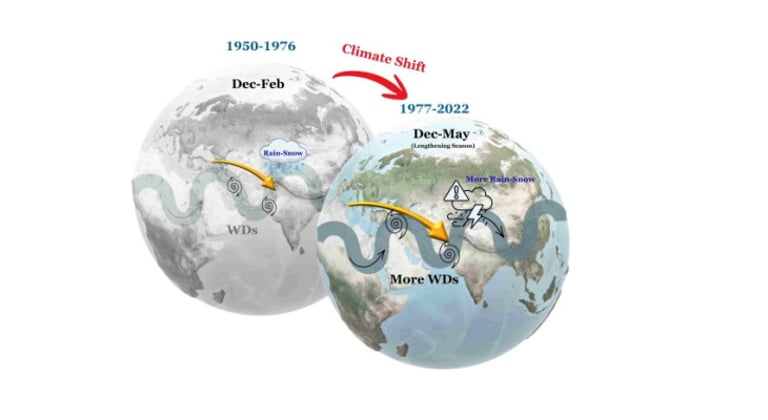

A new IIT Roorkee study shows Western Disturbances shifting beyond the traditional winter window, gaining influence in pre-monsoon months and extending their reach into the Himalayas.
Researchers warn these changes could affect long-term water availability and disaster vulnerability, prompting revisions to climate models, forecasting systems, and disaster management in Himalayan states.
The study emphasizes IIT Roorkee’s effort to translate climate science into policy, urging proactive measures for sustainable development and stronger disaster resilience in a warming climate.
Analyzing seven decades of data, the study finds altered WD pathways, greater moisture uptake, and stronger upper-level winds that amplify rainfall intensity beyond the winter season.
Western Disturbances are traveling farther, gathering more moisture, and triggering heavier rainfall from March to May, increasing risks of flash floods, landslides, and extreme rainfall in the Himalayas and downstream.
The research cites recent extreme events—such as the 2023 Himachal floods and the 2025 Uttarakhand floods—as evidence of evolving WD influence, including during the monsoon period.
Key recommendations call for dynamic, region-specific forecasting, integrated science-governance planning, and infrastructure adaptation to bolster climate resilience in ecologically sensitive Himalayan regions.
Summary based on 1 source
Get a daily email with more Science stories
Source
BW Education • Feb 12, 2026
IIT Roorkee Research Highlights Emerging Climate Signals In Himalayan Weather Systems - BW Education