Earliest Protocluster JADES-ID1 Challenges Cosmic Formation Theories with Unexpected Maturity
February 4, 2026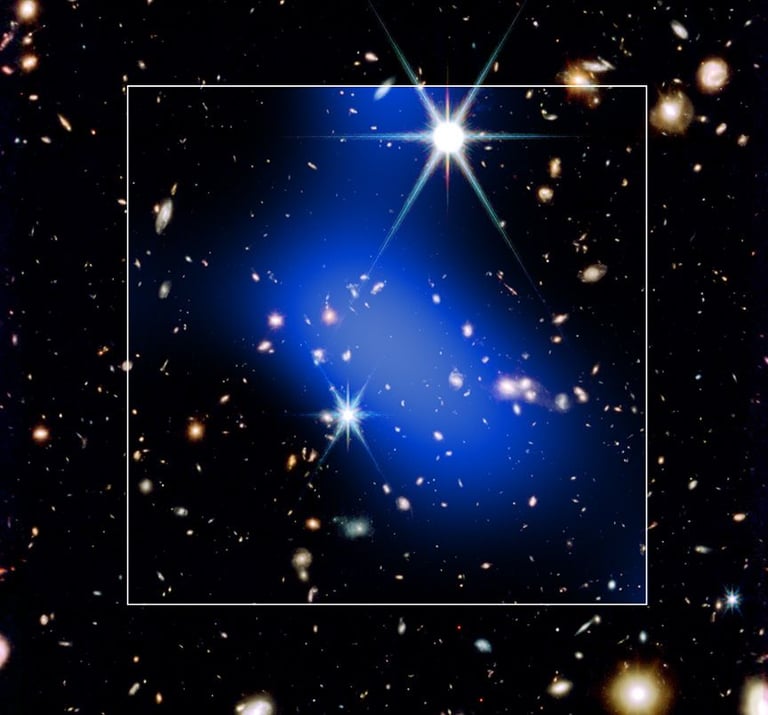

A remarkably mature protocluster named JADES-ID1 has been identified from roughly one billion years after the Big Bang, making it potentially the earliest and most distant such structure observed.
This protocluster appears unusually mature for its age, with prior records showing protoclusters forming around three billion years after the Big Bang.
Researchers say discoveries like this help refine understanding of dark matter’s role, since clusters are bound by dark matter halos and filled with hot gas.
JADES-ID1 contains at least 66 young galaxies and has a total mass around 20 trillion solar masses, with most of that mass in dark matter and a hot gas atmosphere emitting X-rays detectable by Chandra.
The finding highlights the value of JWST and Chandra in studying how cosmic structures assemble and could influence revisions to theories about the cosmic web and cosmological parameters if further evidence supports such early, massive protoclusters.
Lead author Ákos Bogdán notes the need to confirm whether JADES-ID1 is representative of an early growth path or an outlier, while collaborators say future, more sensitive X-ray telescopes will be needed to refine understanding of these extreme systems.
JWST enables this look back in time by detecting light from extremely distant objects whose photons have traveled billions of years to reach Earth.
The X-ray-emitting atmosphere signals a highly active, rapidly growing cluster, making JADES-ID1 the youngest known protocluster with an X-ray–bright atmosphere and pushing the observed protocluster era earlier than previously recorded.
Observations were made with NASA’s James Webb Space Telescope and the Chandra X-ray Observatory, with the findings published in Nature on January 28, 2026.
The results challenge standard models of cluster formation, suggesting either unusually rapid early growth or gaps in current cosmological models, though researchers caution that more studies are needed before revising theories.
Further study of the processes driving rapid early structure formation is needed to determine if this hints at new physics or gaps in current simulations.
JADES-ID1 appears to host at least 66 potential member galaxies bound by gravity, within a massive hot gas cloud, confirming it as a protocluster.
Summary based on 2 sources
Get a daily email with more Science stories
Sources
Scientific American • Feb 4, 2026
Astronomers find a ‘baby cluster’ of galaxies that could break cosmic models
Smithsonian Magazine • Feb 4, 2026
Astronomers Spot a Huge Cluster of Galaxies Forming Earlier in Cosmic History Than Thought Possible