OpenAI AI Finds 948 Linux Kernel Flaws, but Fixes Still Need Review
November 4, 2026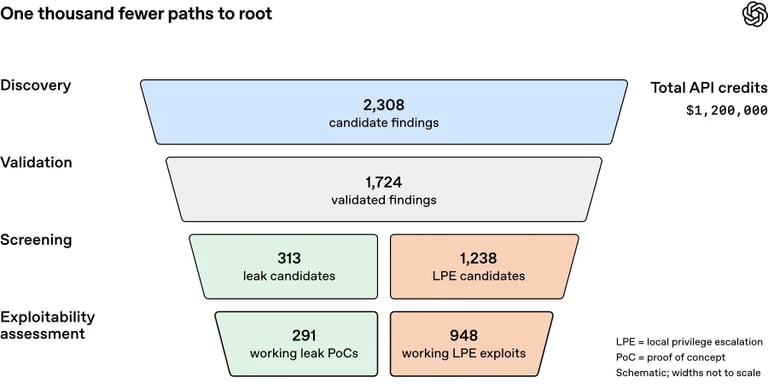

OpenAI says an autonomous cybersecurity system found 948 distinct Linux kernel privilege-escalation vulnerabilities, developed working exploits and drafted candidate fixes for human review.
The work was conducted in virtual machines running an unmodified desktop Linux setup with protections including KASLR, SMEP and SMAP enabled; researchers reviewed the exploits, proposed fixes and severity assessments before reporting them.
The exploits showed how an ordinary local user could gain root access on a stock desktop Linux distribution, but they did not provide a way to break into a machine remotely without first gaining a foothold.
Root access can give an attacker broad control, including the ability to install malware, steal data, change settings or disable security tools.
OpenAI says the run used $1.2 million in API credits—about $1,279 per completed exploit—compared with reported market prices of $20,000 to $70,000 for comparable findings.
In a July run, GPT-5.6 Sol found 166 unique bugs for $513,690; the October model found more than five times as many despite three months of kernel hardening.
The pipeline automated vulnerability discovery, validation, exploitability assessment and patch generation, while human researchers reviewed the results before disclosure to maintainers.
OpenAI said repeated testing improved candidate patches, but early versions sometimes added unnecessary code, risked performance costs or missed related vulnerability variants.
The results are a substantial research effort, not proof that all 948 fixes were accepted, released or installed; discovery, reproducible exploits, candidate fixes and deployed updates are separate stages.
Linux maintainers must assess and reproduce findings, review proposed changes and consider unintended effects, while distributors and operators need to determine affected versions and deliver and verify applicable updates.
A stronger measure of real-world impact is whether findings are accepted, patches withstand review and repairs reach supported releases and users—not the headline research total or model branding.
The same capabilities could help attackers develop exploits, making it critical for defenders to fix vulnerabilities faster than adversaries can exploit them.
Summary based on 27 sources
Get a daily email with more Tech stories
Sources

TechRadar • Nov 5, 2026
OpenAI says its cyber model found and patched nearly 1000 Linux kernel security issues
How-To Geek • Nov 5, 2026
OpenAI used AI to find nearly 1,000 ways for hackers to hijack Linux
CSO Online • Nov 5, 2026
OpenAI built an AI pipeline to find, exploit and patch Linux flaws
The Hacker News • Nov 5, 2026
OpenAI AI Pipeline Generates 948 Linux Root Escalation Exploits in 30-Hour Run