New AI Model Outperforms Humans in Detecting Methane Plumes at Major Landfills
September 9, 2026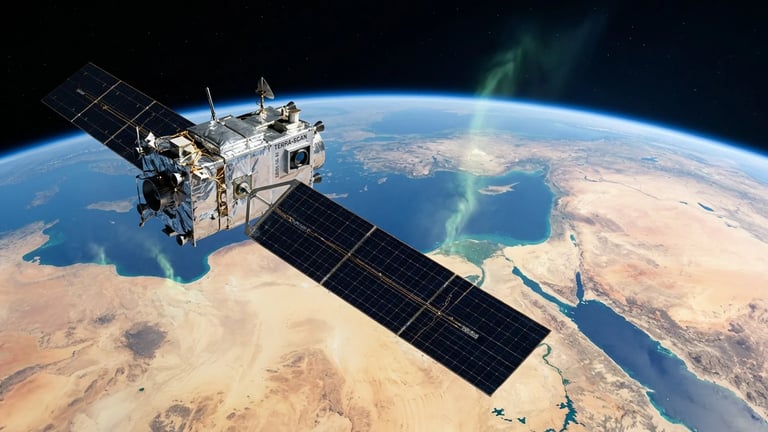

A state-of-the-art model detects methane plumes at 24 of the world’s 25 largest landfills and shows stronger signal-to-noise and accuracy than earlier methods, aligning well with AVIRIS-3 data and controlled-release experiments.
Trained on 3.6 million synthetic plume simulations, the model identifies more plumes and localizes sources more accurately than human analysts, including at 24 of the planet’s biggest emitters.
Looking ahead, the work aims to extend to multi-gas and multi-satellite retrievals and to end-to-end emission-rate estimation, with NASA planning next-generation imaging spectrometers to boost coverage.
Limitations include residual false positives in complex terrain and incomplete EMIT L2B plume catalog coverage, but researchers published a confidence-tagged global plume database and visualization tools alongside the study.
MAPL-EMIT employs a vision transformer architecture (Swin-v2-S encoder with a U‑Net-like decoder) to quantify methane enhancements, delineate plume boundaries, and localize emission sources in a single pass over EMIT scenes.
To address scarce real-world labels, authors generated synthetic plumes with Lagrangian puff models and inserted them into real EMIT scenes using radiative transfer with HITRAN data, training over roughly 96 hours on 32 Google TPUs.
MAPL-EMIT is a joint Google Research and NASA JPL project that detects, quantifies, and localizes global methane plumes via the EMIT instrument aboard the International Space Station.
Validation on real benchmarks shows MAPL-EMIT captures 84% of hand-annotated plume complexes and finds about 1.5× as many plausible plumes as human analysts, with a conservative false-positive rate around 0.06 plumes per granule.
Synthetic benchmarks reveal per-plume precision from 0.80 to 0.97 as plume strength rises, recall from 0.33 to 0.93, and mean source-location error near 101 meters, with notable improvements in emission-rate sensitivity over prior models.
Summary based on 1 source
Get a daily email with more AI stories
Source

Unite.AI • Sep 9, 2026
Google and NASA JPL Unveil AI Model Mapping Global Methane Plumes