SpaceX's Starmind: Revolutionizing AI Processing in Space with Nvidia-Powered Satellites
August 5, 2026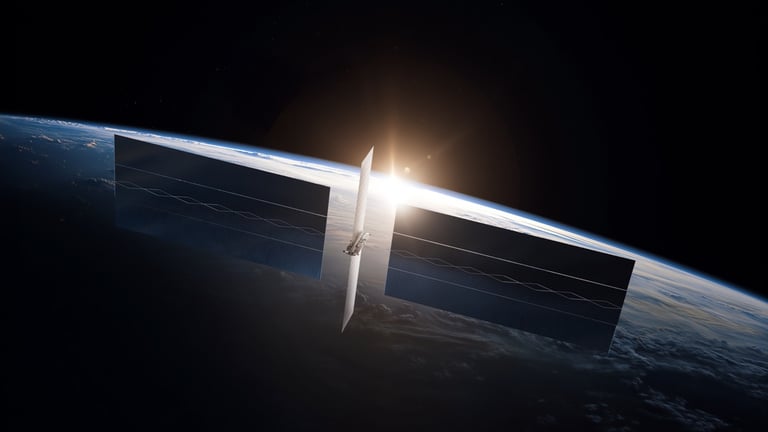

SpaceX’s Starmind project, powered by Nvidia’s Rubin GPUs and Vera CPUs, aims to move AI processing into orbit, reinforcing Nvidia’s dominant CUDA-enabled software ecosystem and creating potential revenue upside through sustained AI chip demand.
Each Starmind satellite will operate with Nvidia Rubin GPUs and Vera CPUs to enable advanced onboard AI processing, linking directly to the Starlink network for fast data transmission.
The initiative seeks to bypass ground-based bottlenecks by moving processing into space, reducing reliance on terrestrial power grids and cooling infrastructure.
Starmind satellites will connect to Starlink via terabit-speed laser links, delivering about 3 milliseconds of end-to-end latency between space-based compute and user devices and minimizing terrestrial constraints.
Elon Musk frames Starmind as part of a broader Kardashev-scale ambition, envisioning up to 1 terawatt of space-based computing and long-term ideas like lunar chip and solar panel production and even lunar-based satellite deployment concepts.
Data centers in sun-synchronous orbit powered by solar energy will use vacuum cooling with deployable liquid radiators to dramatically cut cooling energy needs.
Industry insights note that building a 1-GW AI data center could cost tens of billions of dollars, with long payback periods and potential impact from slower hyperscaler capex.
Musk’s approach is highlighted: bold goals and direct bottleneck tackling accelerate progress across ambitious projects like Starmind and other AI initiatives.
SpaceX and Tesla are pursuing mass production of AI satellites through the Terafab project, planning a large-scale Gigasat factory in Bastrop, Texas, with aims for late-2027 deployment and Starship launches.
SpaceX CFO Bret Johnsen frames Starship as the enabler to deploy thousands of AI satellites and scale space-based computing toward ambitious energy and throughput goals.
NVIDIA is evaluating lower-capacity memory configurations for the Rubin Ultra AI chip amid shortages, with no final decision yet.
SpaceX’s ongoing expansion, including Starlink and Starship, will increasingly rely on high-performance computing for data analysis, simulations, and autonomous decision-making.
Summary based on 4 sources
Get a daily email with more AI stories
Sources

TradingView • Aug 5, 2026
Key facts: SpaceX picks NVIDIA Blackwell; NVDA backs OpenAI;Corvex GPU
TeslaNorth.com • Aug 4, 2026
SpaceX, Nvidia Partner to Bring Rubin GPUs to Starmind AI Satellites | TeslaNorth.com
KuCoin • Aug 5, 2026
SpaceX and NVIDIA Launch Starmind: AI Computing Network in Space
Blogger • Aug 5, 2026
Elon Musk’s SpaceX Makes Nvidia GPUs Its AI Hardware Choice