AI Infrastructure Dilemma: Balancing Software Innovation with Physical Constraints and Financial Risk
June 28, 2026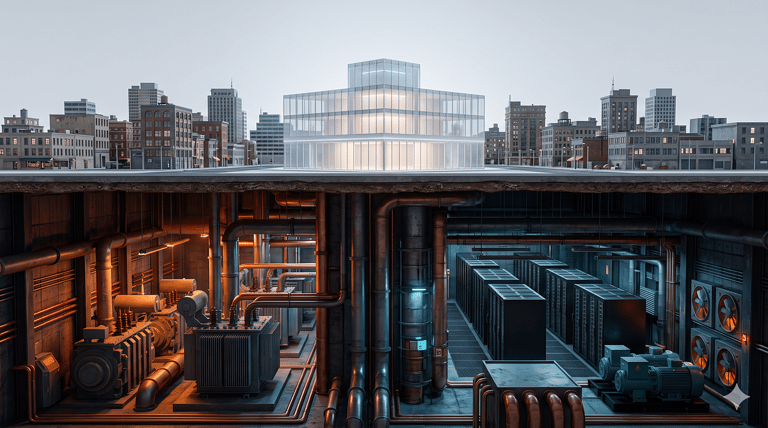

AI deployment rests on two layers: a competitive software model layer on top and a slow-moving physical infrastructure layer that underpins AI at scale.
Memory, high-bandwidth memory scarcity, and long-term supplier commitments show that demand visibility does not equal revenue, and capacity planning is tightly bound to physics and financing.
Leaders should separate usage from capacity and revenue, distinguish fast versus slow-moving components, recognize commitments versus realized outcomes, and understand how architectural changes ripple across the entire stack while identifying who bears expansion risk.
Custom silicon reshapes where value is created across the stack, shifting workloads and how capacity is allocated rather than removing the need for the full infrastructure.
Power, cooling, and connectivity are integral to AI deployment, with financing terms like deposits, take-or-pay, and leasing reflecting how expansion risk is shared between suppliers and buyers.
Manufacturing bottlenecks remain concentrated in leading-edge fabs and equipment suppliers, constraining supply regardless of software demand.
Compute hardware is evolving from merchant GPUs to a mixed ecosystem of GPUs, custom accelerators, memory, and networking, coordinated within data-center environments.
The lower infrastructure layer—data centers, chips, memory, cooling, power, and connectivity—drives long lead times, capital needs, and complex supply chains, slowing adaptation.
The upper layer of models, software, and workloads can be repriced and rerouted rapidly, enabling cost efficiency and competitive differentiation.
A dual perspective is needed: celebrate cheaper, flexible models while actively planning and managing the heavy, capital-intensive basement that enables scalability.
Capital structures, including SPVs, leases, and guarantees, are central to scaling AI infrastructure, highlighting that economics and risk are as crucial as software innovation.
AI should be viewed as a building with a basement of physical systems; a purely cloud-based, soft-layer view is insufficient.
Summary based on 1 source
Get a daily email with more AI stories
Source

Medium • Jun 27, 2026
AI Is More Than Models. It Is an Industrial System.