OpenAI Launches GPT-Rosalind: Cutting-Edge AI for Life Sciences and Biosecurity
June 4, 2026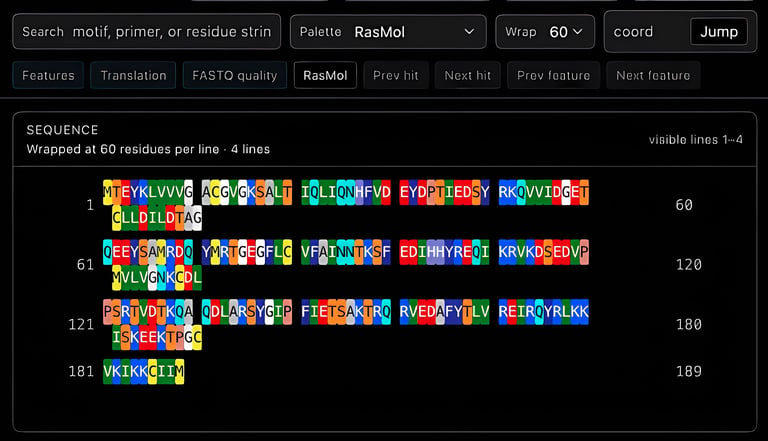

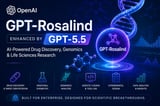
OpenAI released an upgraded GPT-Rosalind, a life-sciences focused AI model that combines GPT-5.5 level reasoning and coding with stronger expertise in medicinal chemistry, genomics, and drug development.
A substantial update on June 3, 2026, enhances domain-specific performance for drug discovery, genomics, and wet-lab research, and opens a research preview to eligible organizations worldwide for the first time.
The upgrade blends features from GPT-5.5 and strengthens capabilities in medicinal chemistry, quantitative biology, and wet-lab troubleshooting to support drug discovery and laboratory analysis.
New interactive viewers for biological file types enable researchers to inspect evidence in context and pose follow-up questions during workflows.
The program aims to accelerate early threat detection, outbreak modeling, screening capabilities, preparedness planning, and development of medical countermeasures for national security and public health missions.
The NGS Analysis plugin handles single-cell and bulk RNA-seq QC and annotation, routes requests, validates inputs, preserves provenance, and generates auditable outputs like MultiQC reports and count matrices.
OpenAI emphasizes biosecurity through a trusted-access deployment model, with safeguards against dual-use risks and collaboration with government and research institutions for governance.
LabWorkBench is introduced as a benchmark to evaluate performance on real-world wet-lab protocols, linking experimental changes to outcomes for troubleshooting and optimization.
Rosalind Biodefense is highlighted as a capability to support high-impact public safety work, expanding biological reasoning and long-horizon research workflows with qualified organizations.
Globally, CEPI uses the tool to speed vaccine design for its 100 Days Mission during Ebola outbreaks, while Fourth Eon Biosecurity uses it to screen DNA synthesis orders for malicious sequences.
Release notes acknowledge that benchmark performance does not guarantee clinical outcomes, noting the historical gap between AI benchmarks and drug development milestones and that FDA AI guidance focuses on regulatory decisions rather than discovery.
OpenAI signals a shift toward domain-specific AI systems that act as collaborative research partners to accelerate discoveries while preserving scientific rigor.
Summary based on 7 sources
Get a daily email with more AI stories
Sources

Interesting Engineering • Jun 4, 2026
OpenAI partners with US govt for bio-weapons detection and threat preparedness
Tech Times • Jun 4, 2026
GPT-Rosalind Drug Discovery Update: OpenAI Cuts Genomics Compute, Expands Global Access