AI-Driven Aerospace Revolution: Physics-Constrained Design Transforms eVTOL and Urban Mobility
May 25, 2026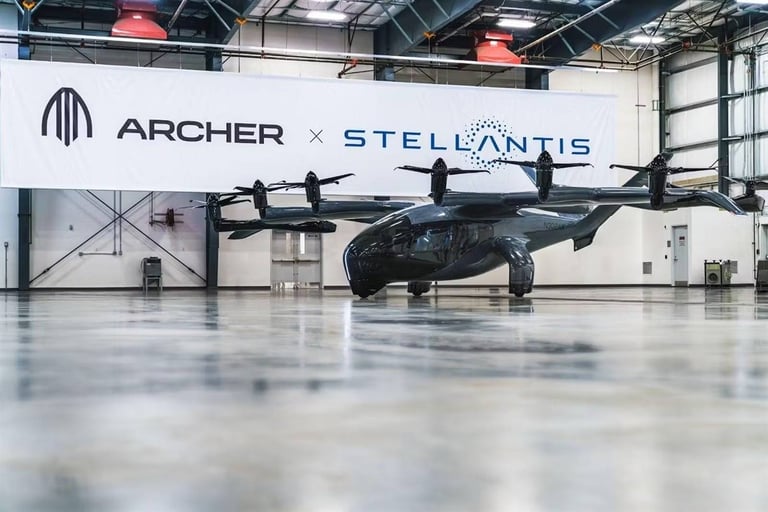

Physics-Constrained AI embeds thermodynamics, fluid dynamics, and structural mechanics into neural networks, ensuring designs adhere to physical laws and reducing dependence on costly high-fidelity simulations.
The aerospace sector is being reshaped by electric vertical takeoff and landing (eVTOL) aircraft, emphasizing high structural efficiency, energy management, and urban air mobility.
An industrialization loop blends physics-constrained design, topology optimization, digital twins, and AI-driven additive manufacturing to create an autonomous lifecycle for aerospace components, a path being piloted by Wisk Aero and others.
Engineering roles shift from iterative CAD drafting to directing intent—setting boundary conditions and performance targets while AI explores the design space for optimized solutions.
AI-optimized designs are manufactured via additive manufacturing (DMLS), with physics-informed models predicting build behavior, warp, residual stress, and defects, enabling pre-deformation and in-situ monitoring.
The outlook is that embedding physical truths into AI will yield faster, more precise, and more trustworthy flight hardware, propelling aerospace and urban mobility forward.
AI-driven topology optimization within a multi-objective framework yields lightweight, thermally efficient components with biomimetic geometries and substantial weight reductions (30–50%) by balancing rigidity, thermal dissipation, and manufacturing constraints.
Real-time digital twins enabled by PINNs provide physics-informed estimates of structural and aerodynamic behavior via reduced-order models, enhancing monitoring, fatigue-life assessment, and control under variable flight conditions.
Pure AI lacks inherent physics; incorporating PDE residuals guides training to physical feasibility, enabling near-real-time design estimates and faster optimization.
Summary based on 1 source
Get a daily email with more AI stories
Source
Engineering.com • May 25, 2026
The physics-constrained AI breakthrough in aerospace and eVTOL