Open-Source AI Market Set to Soar: Alibaba Leads with Qwen3 and $50 Billion Projection by 2030
February 16, 2026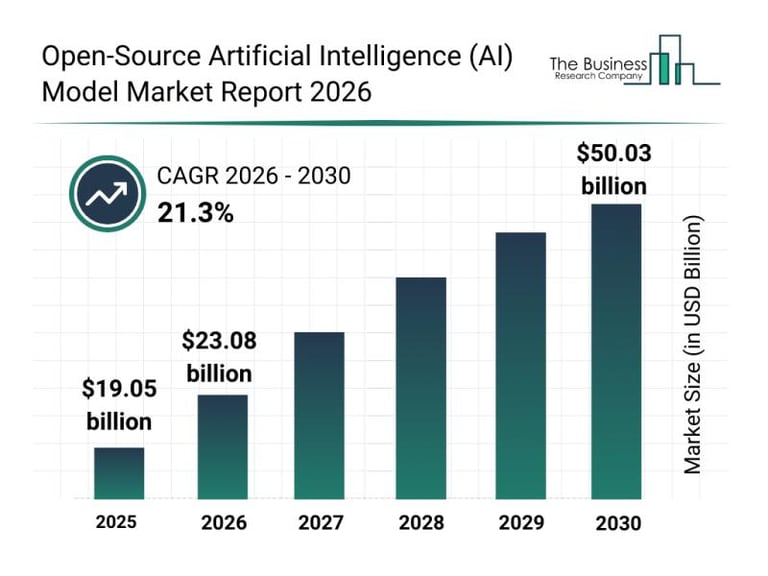

The market is being reshaped by community-driven model development, enterprise-focused open weights for large language models, expanded developer toolchains, and growing transparency and explainability, alongside the rise of open-source AI marketplaces and repositories.
Subsegments span a wide range of capabilities, from NLP tasks like classification and translation to computer vision, speech recognition, recommendation strategies, predictive analytics, generative outputs, and reinforcement learning, covering both foundational tasks and advanced workflows.
A notable development is Alibaba’s Qwen3 family, unveiled in early 2025, featuring dense and Mixture-of-Experts architectures, hybrid reasoning, and deployment versatility from mobile devices to autonomous systems to boost performance and cost efficiency for enterprise use.
The market is shaped by major tech players and open-source contributors, including Amazon, Apple, Google, Microsoft, Meta, Alibaba, IBM, NVIDIA, OpenAI, and communities like Hugging Face and Stability AI, with notable moves such as Databricks’ MosaicML acquisition strengthening generative AI capabilities.
The release highlights the market’s breadth and innovation potential, emphasizing autonomous or agentic AI and the ability of open-source models to execute multi-step workflows and interface with external tools.
The open-source AI model market is projected to reach about $50 billion by 2030, growing at roughly 21% annually, driven by demand for vendor-neutral solutions, regulatory transparency, edge/on-prem deployments, and expanding generative AI applications.
Market segmentation spans type (NLP, Computer Vision, Speech, Recommendation, Predictive Analytics, Generative, Reinforcement Learning), deployment (on-premise vs. cloud), licensing (permissive, restricted, copyleft), application (NLP, content/code generation, etc.), and end users (enterprises, academia, developers, individuals).
Summary based on 1 source