Anthropic's Claude Opus 4.7 Outpaces Human Teams in Robot Control, Signaling AI's Autonomous Future
June 18, 2026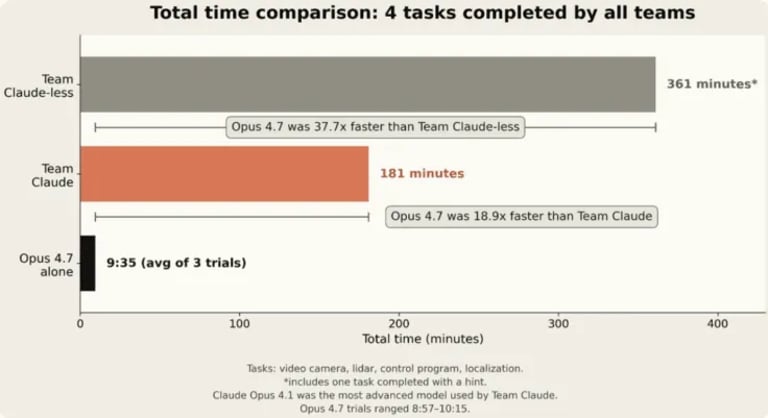

Anthropic’s Project Fetch Phase Two tested Claude Opus 4.7 via Claude Code on a robotic quadruped, completing tasks faster than human teams.
Opus 4.7 achieved this while generating almost ten times less code than humans, signaling greater efficiency with concise AI-generated software.
In the second stage, Claude Opus 4.7 operated with partial autonomy, independently generating the software to control the robot, with humans limited to initialization and command approval.
The company notes that more research is needed to tailor control policies or hardware designs to specific tasks and acknowledges barriers to a fully generalized vision of physically capable language models.
Overall, AI models are moving toward using off-the-shelf physical tools with increasing autonomy, marking an early era of physical agentic AI, though reliability and task-specific control policies still require substantial work.
This is framed as an early signal of physical agentic AI capable of leveraging existing hardware for limited tasks, yet significant research remains for robust control policy design and robot adaptation.
A remaining limitation was a final autonomous task where the robotic dog had to return a ball; Claude identified the ball and prepared the robot but failed to execute real-time, closed-loop control.
Experts expect AI–robot collaboration to soon reduce human labor in manufacturing, logistics, and service sectors, enabling broader automation.
Results fit into Anthropic’s autonomy strategy, including studies on AI’s impact on labor markets showing productivity gains rather than mass layoffs, with mixed worker attitudes toward AI.
Photo credit: miss.cabul on Shutterstock.
Efficiency gains stem from general model scaling rather than robotics-specific optimizations, reflecting a trend where AI first augments human ideas, then operates more independently in new environments.
Broadly, targeted robotics improvements came more from model scaling and general capabilities than task-specific optimization, aligning with a pattern where models assist humans, then humans assist models, and eventually models take on more autonomous work.
Summary based on 7 sources
Get a daily email with more AI stories
Sources

Dailyhunt • Jun 18, 2026
Anthropic Makes 'Fetch' Happen As New Claude Models Beat Human Teams on Robotics Planning Tasks
Anthropic • Jun 18, 2026
Project Fetch: Phase two
Zamin.uz • Jun 18, 2026
Anthropic's Claude Model Outperforms Humans in Robot Control
Crypto Briefing • Jun 18, 2026
Anthropic’s Project Fetch shows Claude-assisted team finishing robodog coding in fraction of the time