First Primitive Star Found in Dwarf Galaxy Sheds Light on Universe's Chemical Evolution
March 20, 2026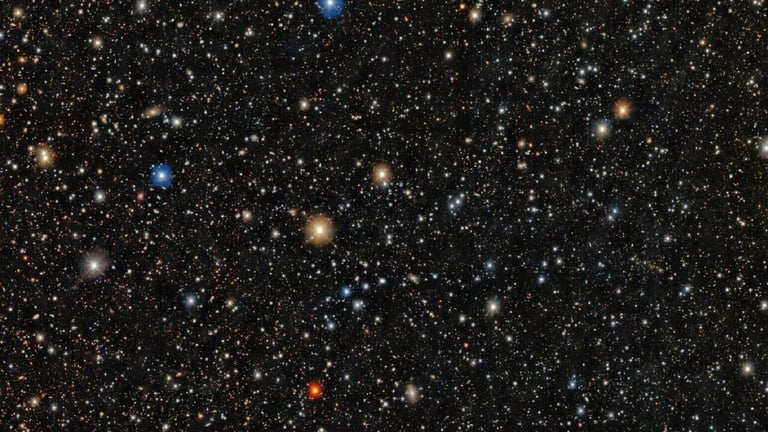

A landmark finding identifies PicII-503 as the first confirmed primitive star in a faint dwarf galaxy, shedding light on the universe’s transition from hydrogen and helium to heavier elements, with the research published in Nature Astronomy.
PicII-503 exhibits an unusually high carbon abundance despite its extreme iron scarcity, with a carbon-to-iron ratio vastly exceeding that of the Sun, signaling a primitive chemical signature.
The star harbors roughly 1/40,000th of the Sun’s iron while maintaining a carbon-to-iron ratio over 1,500 times solar, highlighting its carbon-rich, iron-poor nature.
As a second-generation (Population II) star, PicII-503 preserves chemical fingerprints from the first stars (Population III) that ended life in explosive supernovae.
PicII-503 is observed within its original dwarf galaxy, Pictor II, about 150,000 light-years from Earth—a rare glimpse into the early universe.
Located in Pictor II, PicII-503 offers a rare window into primordial conditions, remaining in its birth galaxy rather than migrating.
Findings support the idea that during a star’s violent supernova, lighter carbon in the outer shell can be expelled farther than heavier elements, contributing to carbon’s widespread presence.
Observations were captured by the Dark Energy Camera on the Víctor M. Blanco 4-meter Telescope in Chile, with the study noted by researchers.
The star was identified through a survey of ancient stars and confirmed with follow-up observations from the Very Large Telescope and Magellan Telescope.
PicII-503 remains within its primordial dwarf galaxy, enabling tests of elemental distribution theories without confounding stellar migration.
Researchers describe the discovery as cosmic archaeology, using PicII-503 as a fossil to study early stellar populations and elemental evolution.
A leading explanation is that the first supernovae were relatively low-energy, ejecting lighter elements like carbon while iron fell back, aided by the dwarf galaxy’s weak gravity.
Summary based on 2 sources
Get a daily email with more Science stories
Sources
The Indian Express • Mar 20, 2026
‘Cosmic archaeology’: Meet PicII-503, the most chemically primitive star ever found outside the Milky Way